
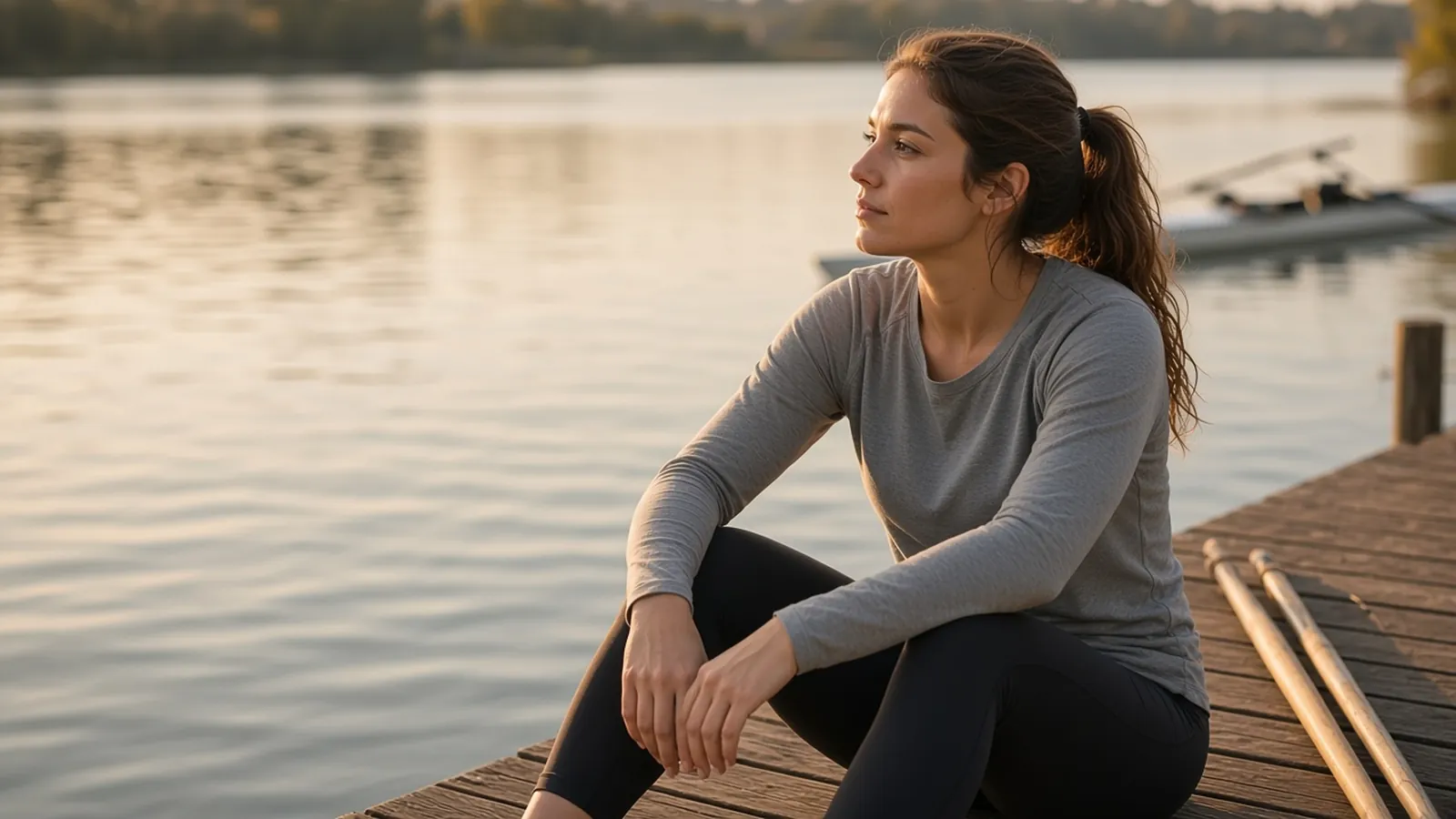
Some weeks your body shows up and your head doesn't. You sleep badly before a final, an injury takes you out for two months, you miss the national team roster or you start thinking about quitting and don't know who to tell. It happens to volleyball players, to tennis players who travel alone, to handball pivots and to swimmers whose season hangs on a cut time.
In August 2026, the International Olympic Committee (IOC) published a new consensus statement on athlete mental health at the elite level. This guide covers what it says, which numbers exist and how to read them, what athletes can do, what falls on coaches and staff, and where to get help in the US, Canada, the UK and other countries.
This article is for information only. It isn't a diagnosis and doesn't replace care from a mental health professional. If you're in danger right now, call your local emergency number or go to the nearest emergency room. Helplines are listed below.
What the 2026 IOC consensus is
The statement was published on August 12, 2026, in the British Journal of Sports Medicine and updates the IOC's 2019 consensus (Reardon, Gouttebarge et al., 2026). An expert group ran a systematic literature review and voted on recommendations using the Delphi method, which builds agreement over several rounds. According to the full text, the panel had 31 members with clinical, scientific or lived experience. It included an athlete representative, chosen from the IOC's mental health ambassadors, and two representatives of international sports federations.
The abstract lands on three main points. Mental health symptoms and disorders are common among elite athletes. They can have causes and presentations tied to sport. And they can affect performance.
It also makes a concrete recommendation: screen for and monitor symptoms with validated tools, at set points in the season and after major events. And it notes that, with the right support and treatment, many athletes with symptoms can keep training and competing safely. Sometimes participation needs to be modified.
Mental health moves along a continuum
The consensus describes mental health as a continuum. Well-being sits at one end, symptoms and disorders at the other, and athletes move along it over time. Short-term stress before a tournament isn't the same as a disorder, but you don't need to wait until something is "serious" to talk about it.
A 2026 synthesis on how sport should record this kind of data separates three levels: problems (non-clinical distress), symptoms (clinical signs) and disorders (Seil-Moreels et al., BJSM, 2026). That helps everyone talk more precisely. An athlete saying "I'm not OK" doesn't mean they have a disorder, and not having a diagnosis doesn't mean they don't need support.
What the numbers say (and why they vary so much)
Read the figures carefully, because they depend on how researchers measured and who they studied. Here are some of the data points the consensus pulls together:
- Depressive symptoms. Studies of elite athletes report anywhere from 1% to 68%, depending on the sample, the questionnaire and the timing. Symptoms ran highest mid-season compared with preseason and the offseason.
- Anxiety. Among 221 elite athletes seeking care at outpatient clinics in Sweden, 69% met criteria for an anxiety disorder. That group had already asked for help, so it doesn't represent all athletes.
- Burnout in young athletes. In adolescent elite athletes, one study cited in the consensus found 21.8% with medium burnout levels and 9.1% with severe levels.
- Sleep. Several studies estimate elite athletes average about 6.5 hours of sleep, below the recommended 7. In some groups, likely insomnia goes above 25%.
The consensus also points out that coaches, medical staff and others in the athlete's entourage have mental health symptoms too. This isn't only an athlete issue.
We already have a practical guide on sleep, with schedules, caffeine, screens and travel: sleep for athletes.
Burnout, overtraining and depression aren't the same thing
They overlap and get mixed up. The consensus separates them like this:
- Athlete burnout. Physical and emotional exhaustion, a reduced sense of accomplishment and devaluing the sport. Symptoms usually stay within sport.
- Overtraining syndrome. Physical exhaustion, a measurable drop in performance and mood changes. Studies cited put it at 7% to 18% of elite athletes, though it's hard to measure because it lacks clear diagnostic boundaries.
- Major depressive disorder. Symptoms have to last at least two weeks and show up across different parts of life, not just in sport.
Telling them apart is a job for a professional, and it matters because treatment differs. Cutting training load may help with overtraining and fall short with depression.
Times to pay closer attention
The consensus flags higher-risk situations:
- Injury. It recommends assessing the psychological response to injury, keeping injured athletes in contact with the team and checking psychological readiness to return, not only physical readiness.
- Concussion. In contact sports like rugby, ice hockey or soccer, it calls for monitoring mental health symptoms after a concussion.
- Transitions. Moving up or down a level, a transfer to another team (sometimes to another country and culture), coming back from a major event, time out for injury, illness or pregnancy, deselection and retirement, which is the most studied. Around retirement, risk goes up with involuntary retirement, career dissatisfaction, injury or chronic pain, little planning for what comes next and limited support outside sport.
- Social media. It can help athletes feel connected or cause harm through abuse, cyberbullying or lost sleep. The consensus asks clinicians to talk about social media use with athletes.
- Interpersonal violence. It's linked to more mental health symptoms. The consensus says everyone in the sport ecosystem is responsible for protecting athletes.
- Gambling and other behavioral addictions. These are often "hidden" disorders that only come up when someone asks directly.
- Young athletes. Many disorders start before age 18, and at that age training load stacks on top of school.
- Para athletes. They face their own stressors, including disability stigma, classification, inaccessible venues and the cost of equipment.
Why asking for help is hard
The consensus lists the most common barriers: stigma, low mental health literacy, cultural beliefs, fear of being judged, worry about losing opportunities (getting cut, losing a scholarship spot or a contract) and practical issues like cost or not knowing where to go. Confidentiality concerns come up too.
Some countries built specific answers. The consensus mentions that Australia has a free mental health network for elite athletes and Sweden runs a no-cost specialized clinic for them. Most countries don't have anything like that, which is why it helps to know the general resources listed at the end of this guide.
What athletes can do
- Talk to someone you trust. A teammate, family, the team doctor, your athletic trainer or the team psychologist if there is one. "I haven't been OK for a few weeks" is enough to start.
- See a mental health professional. The consensus names psychotherapy as a foundation of treatment, alone or combined with other approaches. If medication comes up, say that you compete. Some medications may need a Therapeutic Use Exemption, and your doctor should check the World Anti-Doping Agency's Prohibited List.
- Protect your sleep. It's one of the areas where habit changes can do the most.
- Build a life outside sport. Classes, a part-time job or other interests don't make you less of an athlete. They hold you up when an injury or retirement shows up. For a plan, read our guide to the athlete dual career.
- Check your relationship with social media. If one comment ruins your day or keeps you up, muting, setting time limits or letting someone else run your account during competition week are all fair options. More ideas in social media for athletes.
What falls on coaches and staff
The consensus says everyone who works in sport should have a basic understanding of mental health: recognizing signs, knowing where to refer and promoting well-being. Coaches and non-clinical staff help spread that information, while diagnosis and treatment stay with licensed professionals.
For clubs, college programs, federations and academies, the practical recommendations are:
- Screening with validated tools. The IOC built its own assessment tools (SMHAT) and recognition tools (SMHRT) for elite athletes. Version 2 of the assessment tool includes validated questionnaires and clinical guidance for physicians and other licensed health professionals.
- A mental health emergency action plan. With defined roles, who gets called and in what order, rehearsed and reviewed.
- Real confidentiality. If an athlete believes what they share will reach the head coach and cost them playing time, they won't share anything.
- Support around transitions. Before and after retirement, including career assistance programs. The IOC and some federations already run them.
- Someone who coordinates. A 2026 BJSM editorial looks at the "mental health lead," a person who coordinates mental health efforts across an organization (Kegelaers et al., 2026). It cites the NBA, where every team must employ at least one licensed mental health professional. The authors note that little is known yet about how organizations run and fund that role.
Sport-by-sport examples
- Basketball and handball. Deep rosters, shared minutes and pressure around roles. A one-on-one conversation about each player's place on the team can take away a lot of uncertainty.
- Volleyball and field hockey. Seasons packed with tournaments and team camps. The consensus flags mid-season as the peak for depressive symptoms, so don't wait for the offseason to check in.
- Tennis and padel. Individual sports with travel, rankings and out-of-pocket costs. Life on tour can be lonely, and it helps to have someone off the court to talk to.
- Rugby. Contact, concussions and long injuries. Psychological recovery belongs in the return-to-play plan.
- Track and field and swimming. A lot rides on a mark or a qualifying time. A bad season can feel like the end, and it isn't.
- Soccer. Trials, transfers, loans and short contracts. Every club change is a transition, and moving abroad adds distance from family.
Where to get help
If there's an immediate risk to your life or someone else's, call emergency services or go to an emergency room. These lines are free and confidential:
- United States. Call or text 988 to reach the 988 Suicide & Crisis Lifeline, 24/7. Chat is available too, and text and chat are offered in Spanish (988lifeline.org).
- Canada. Call or text 9-8-8 (988.ca).
- United Kingdom. Samaritans, 116 123, free, 24 hours a day (samaritans.org).
- Other countries. Find A Helpline lists free helplines by country.
- Olympians and Paralympians. Athletes accredited for Paris 2024 or Milano Cortina 2026 can use the IOC's Mentally Fit Helpline, free, confidential, 24/7 and in 70 languages (details published by the FIH).
If you're on a college team, ask your athletic department or campus counseling center what they offer and save the number where the whole team can find it.
Your career is more than one result
An injury, getting cut or retiring doesn't erase what you've done. On ath.bio you build a profile with your full path: teams, stages, achievements and a video, in one link you can update whenever something changes. The Free plan includes up to 3 career stages and one video. If you're a sport psychologist, strength coach or coach, you can show your background in a staff profile.
FAQ
What does the 2026 IOC consensus say about athlete mental health? That symptoms and disorders are common among elite athletes, can have sport-specific causes and can affect performance. It recommends screening with validated tools, emergency action plans and environments that support well-being.
Do I have to stop training if I have anxiety or depression? Not necessarily. According to the consensus, many athletes with support and treatment can keep training and competing safely. Sometimes participation needs to change, and that decision is made with a professional.
Will the team psychologist tell my coach everything? They shouldn't. Confidentiality is one of the barriers the consensus asks programs to fix. Ask at the start what gets shared and with whom.
Can mental health medication cause a doping violation? Some medications may need a Therapeutic Use Exemption. Tell your doctor that you compete so they can check the World Anti-Doping Agency's list.
This article is for information only and doesn't replace advice from a psychologist, psychiatrist or physician. If you're in danger, call emergency services.