
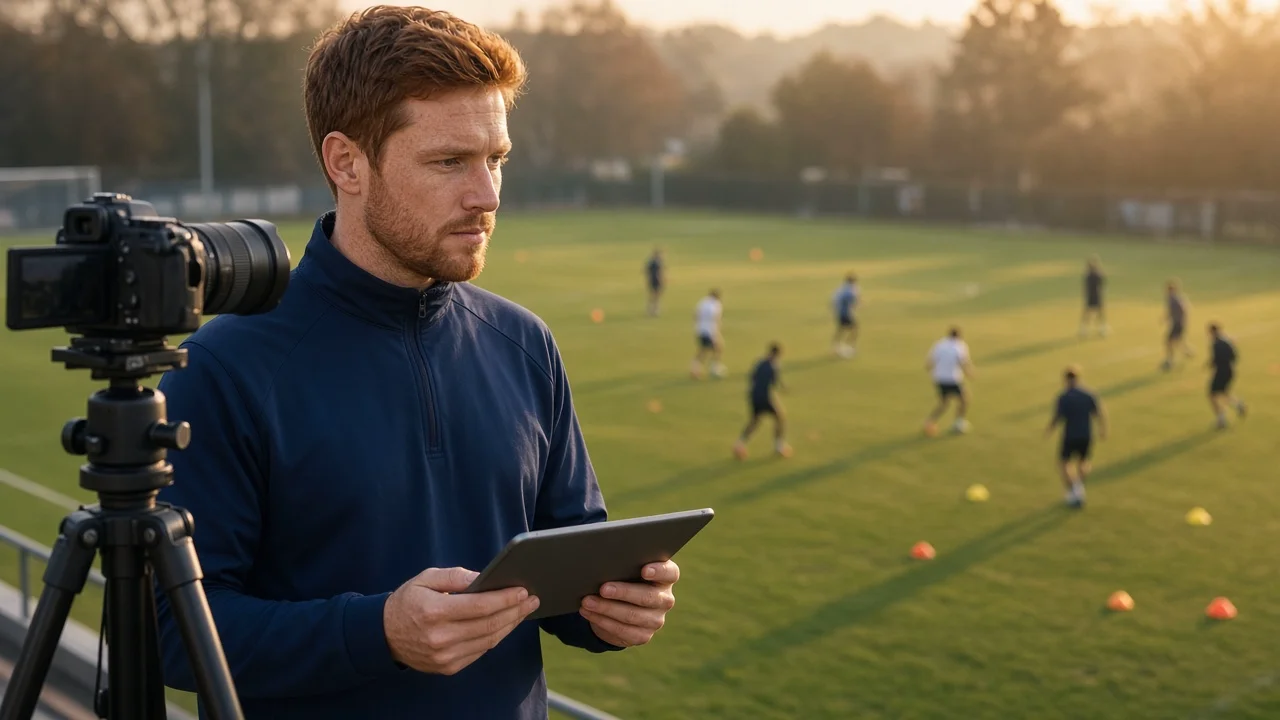
Every staff that builds a game plan needs someone who has watched the opponent more closely than anyone else. That's the football video analyst: the person who scouts the next opponent on film, breaks down your own games and turns what the head coach wants to fix into clips the players actually watch.
This guide is for people who want that job: students, assistant coaches who already do analysis without the title, and analysts looking for their first club. It covers what a soccer video analyst does, the tools that show up in job posts, the training that exists and, above all, how to show your work. In this role you get hired on what you can show, not just on what your resume says.
What does a football video analyst do?
SoccerEDU calls the video analyst "the tactical eye of the coaching staff": someone who works with the head coach and players, uses match and training footage to analyze team and individual behavior, and produces clear, concise video edits (SoccerEDU, 2026).
Day to day, the work covers several fronts:
- Opposition analysis: pre-match reports on the opponent's system, strengths, weaknesses and recurring patterns.
- Post-match review: an objective look at what worked for your own team and what didn't.
- Individual feedback: how each player performs in specific game situations.
- Specific phases: set pieces, build-up, pressing, transitions.
- Video and reports: recording, tagging and editing sequences, then delivering visual reports (video, PDFs, stats) and running video sessions with players and staff.
The setting changes the job. At a professional club, SoccerEDU notes, the analyst is a full member of the technical staff and works with the data, scouting and medical departments. At amateur level or as a freelancer, the analyst often does everything (filming, editing, analysis) and may work remotely for several teams or players.
Video analyst, data analyst and scout: not the same job
- The video analyst studies the game: your team, the opponent and individual players, to help decide how to train and how to play.
- The scout focuses on finding and evaluating players who could join the squad.
- The data analyst works mostly with event data, metrics and dashboards.
On small staffs, one person often covers two or three of these roles. If player evaluation is your side of it, we have a guide on how to write a soccer scouting report.
Tools you'll see in job posts
SoccerEDU lists the software analysts use: NAC Sport, Opta, LongoMatch, Once Video, Hudl Sportscode and Wyscout. It quotes Crystal Palace first-team video analyst Tom Johnson on using platforms such as Wyscout, Opta and Scout7 to deliver the final product to coaches and staff.
You don't need all of them. In practice, the stack breaks down like this:
- Video analysis software: Hudl Sportscode, Nacsport, LongoMatch and similar tools to tag and cut footage.
- Data and video platforms: Wyscout or Opta, depending on the club's level and budget.
- Organization and visualization: spreadsheets or dashboard tools.
- Recording: a camera, a high vantage point and a clean system to store hours of footage.
SoccerEDU's list of technical skills also includes knowing video formats, compression and exporting, writing clear reports and organizing footage efficiently. The software is the easy part to learn. Knowing what to look for is the hard part.
What training do you need?
SoccerEDU states it plainly: the profession isn't governed by a single official diploma. What it highlights instead:
- Tactical knowledge: the laws of the game, playing systems (4-3-3, 3-5-2 and so on) and how to adapt to a coach's philosophy.
- Analytical skills: attention to detail, synthesis, cross-checking video and data, structuring reports.
- Communication: making analysis simple enough to use, often on the night before a match.
- Specialized courses: programs that cover game systems, software, tagging, KPIs and report writing.
Some federations have built formal pathways. In Brazil, for example, the CBF Academy offers tiered licenses specifically for performance analysts (CBF Academy).
A course gives you a method. It doesn't give you experience or a portfolio. That part is on you.
How to show your work: the analyst's portfolio
Analyst schools and agencies that write about the job agree: the most direct way to land a first role is a portfolio that shows how you work. A club looking for an analyst wants to see your clips and reports, not just read that you know Sportscode.
What to include:
- A full opposition report. System, build-up, pressing, set pieces and three or four keys for the match. With clips.
- A post-match review of a team. Your own team or one you follow: what went to plan and what didn't.
- An individual analysis. One player, one position, actions in and out of possession.
- A set-piece breakdown. Short, visual and easy to present in a team meeting.
- Your method on one page. How you tag, which categories you use, how you present to staff and how fast you deliver.
A few rules that make the difference:
- Short wins. A coach with little time watches one short clip per topic, not a full annotated match.
- Always add context. Level, role, who used your work and for what decision.
- Show range. Matches, training sessions, opponents and individual players, not ten copies of the same report.
- Get permission. If you use footage from a club you worked for, ask before you publish it.
- Keep it in one place. If your work is spread over five folders, nobody will open all of them.
If you also cut videos for players, see how to build a soccer highlight video for recruiting. The editing logic is similar.
Where analysts work
SoccerEDU points out that the role, once limited to professional clubs, now shows up at amateur clubs, training organizations and federations, and that freelance work is growing thanks to cheaper cameras and remote analysis software. Typical places to look:
- Professional and semi-professional clubs.
- Youth academies and training organizations.
- Federations.
- Agencies that need player reports.
- Sports technology companies.
- Freelance work for coaches, clubs or individual players.
How much does a football video analyst make?
We're not publishing figures because we didn't find reliable data by country. Pay depends heavily on the club's level, the country, whether you're on staff or freelance, and your experience. The salary tables you'll find online are usually estimates for specific markets. If you get an offer, ask about the scope of the job, who provides the equipment and software, and how many matches a week you're expected to cover.
Your staff profile is your portfolio
If you already have a coaching resume, most of what we explain in how to write a soccer coach resume applies to analysts too: roles with level, licenses and training with the issuing body, and results with context.
ath.bio has a professional profile for staff built for coaches, analysts, physios and managers. You organize roles, training, specialties and projects in one URL that updates with you. In projects, you can describe each piece of work with its context: "opposition reports for a regional club's first team, 2025 season." You can turn on contact requests and get them in Messages, without a paid plan. It doesn't promise jobs. It keeps your experience organized and easy to share when someone asks, "What have you done?"
FAQ
What does a football video analyst do? They analyze matches and training sessions for their own team and opponents, tag and edit clips, write reports and present them to coaches and players.
How do you become a football video analyst? There's no single official diploma. Most analysts combine tactical knowledge, specialized courses and software skills with hands-on work for youth or amateur teams, and build a portfolio of reports and clips.
What software do soccer video analysts use? Commonly cited tools include Hudl Sportscode, Nacsport, LongoMatch and Once Video for video, and Wyscout or Opta for data and footage.
Can a football video analyst work remotely? Sometimes. SoccerEDU describes freelance analysts who work remotely for several teams or players, while at professional clubs the role is usually part of the on-site staff.
Do you need to have played professionally to be an analyst? No. Playing experience can help you read the game, but tactical knowledge, analytical skills and a portfolio that shows your method matter more.