
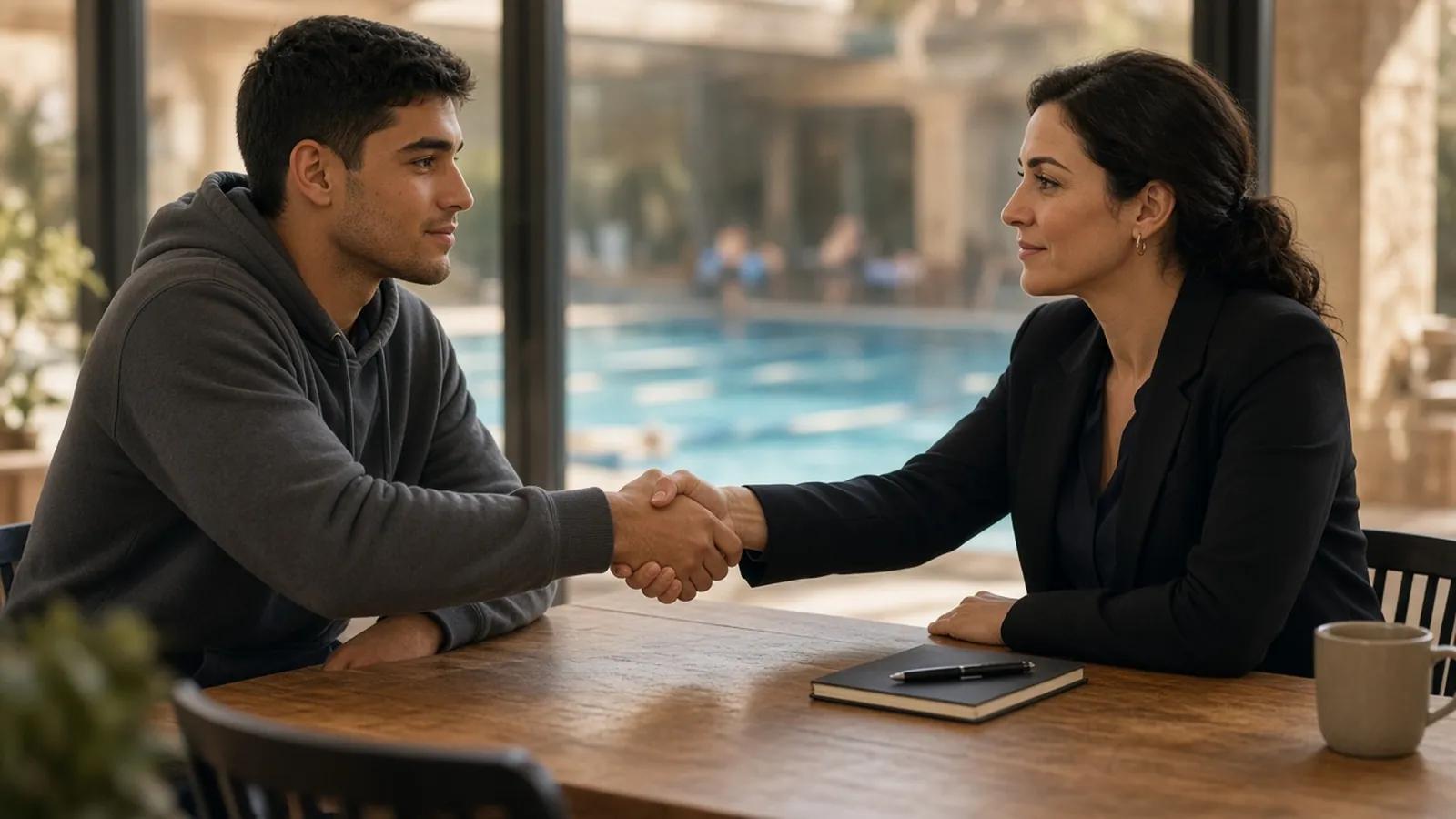
Getting sponsored as an athlete early on is rarely about fame. It starts with a simple question: what do you need to compete, what does a business get from backing you, and who exactly are you asking?
This guide is for athletes 18+ (if you are under 18, a parent or guardian should lead the outreach). It promises no replies and no deals. Most pitches go unanswered. ath.bio does not find sponsors or act as an intermediary; it is where you keep your story and film in one place to share.
Before you write: what are you asking for?
"Would you sponsor me?" leaves the brand to do all the thinking. Guides to individual-athlete sponsorship, from the Australian Sports Foundation to athlete-focused marketing blogs, all start with a specific ask.
- A goal with a date: "compete at the regional championship in March," not "keep improving."
- A real season budget: entry fees, travel, equipment, physio, coaching.
- What can be covered in kind: a gym, a sports shop or a physio can help with product or services, not only cash.
Once you have the total, split it. Three or four small local partners are more realistic than one brand paying for everything.
Who to contact
Start close to home. Sponsors do not have to be sports companies. Look at brands and services you already use, local businesses, and anyone who already backs athletes at your level.
- Check whose logos are on kits, banners and tournament programs in your league or region. That is your prospect list.
- Think beyond sporting goods: health and nutrition, trades, financial services, travel. A real connection to your story matters more than the category.
- Email a named person, the owner or the marketing lead, never the generic inbox. If you can, stop by in person or get an introduction through your club first.
- Pick a few, and tailor each pitch. One copy-pasted proposal sent to 50 businesses shows.
The one-page proposal
A sponsorship proposal is not a resume or a highlight reel. It lets a business understand, in a few minutes, who you are, who you reach and what it gets. A structure that shows up across the guides:
- Who you are in two lines: sport, level, location, what you are chasing this season.
- Results you can show, dated, with a link. If they are modest, show progress.
- Your audience in real numbers: followers, reach, club or school community, crowds. Small and honest beats big and vague.
- What the sponsor gets: logo on kit or bag, a set number of posts with a mention, an appearance, photos or video they can reuse.
- What you need it for: an itemized budget, not a lone number.
- One next step: a 15-minute call, not "let me know if you are interested."
For what goes on the one-pager itself and when to send a PDF versus a link, see athlete media kit. This guide is about the ask.
Short email template (under 150 words)
Subject: Idea for [Business] and [Your Name], [sport] in [town]

Hi [Name],

I'm [Full name], a [sport/position] at [club] in [town]. This season I'm working toward [goal with a date]. I'm writing to you rather than another company because [a specific, true reason: you use the product, they back a local event, a mutual contact].

I'm looking for [2 or 3] local partners to help with [specific part of the season]. In return I can offer [logo on kit/bag, X posts a month tagging you, an appearance at an event] and send you a short recap with photos and reach at the end.

I have a one-page outline and my profile with career and film here: [ath.bio link]. Would you be open to a 15-minute call this week or next?

Thanks for your time,
[Name] · [phone / email]
One sentence that could only be about that business is what makes this a pitch and not a mass email. If you cannot write one, research more or move on.
Following up
A common pattern: follow up once after about five to seven working days, in the same thread, with two lines and the same link (or one relevant update, like a confirmed date or result). Two touches is a reasonable limit. No answer does not mean your ask was bad.
If they say yes
- Put it in writing first: what you deliver and by when, what you receive and when you are paid, any exclusivity, and whether they can reuse your photos or video.
- Label sponsored posts as required by each platform and country. In the US and Canada, for example, sponsored content generally has to be disclosed.
- Over-deliver and keep proof: screenshots, photos, reach. Send a short recap at the end of the season. Your first sponsor is the best reference for the next.
Common mistakes
- Asking for money in the first message with nothing offered back
- The same pitch sent to dozens of companies
- Talking only about what you need
- Inflating followers, results or reach
- Attaching a 12-page deck instead of a clear link
- No follow-up at all, or ten
- Posting before the agreement is in writing
Where to show your story
When a business clicks your link, it should find who you are, your teams, your results and your film in one place. On ath.bio you build a public profile with a photo, bio, clubs and social links (Free plan: up to 3 clubs and 1 video). The Pro plan (USD 29.99 a year) adds sponsors on the profile, a links page, a media kit PDF (sponsors are not in the PDF) and profile-visit analytics. Public example: alexander-barboza. A profile will not land sponsors by itself; it is the introduction you send.
FAQ
Do I need a big following? The guides we reviewed do not treat it as a requirement for local businesses. Fit, proximity and a concrete offer matter more. Use real numbers, even small ones.
How much should I ask for? Start from your real season budget and split it into parts. There is no universal figure.
Does ath.bio find me sponsors? No. It is a profile you share to present your career. You do the outreach.
What if nobody replies? Follow up once after about a week, then move on. Rework the pitch if your reason for contacting them was thin.