
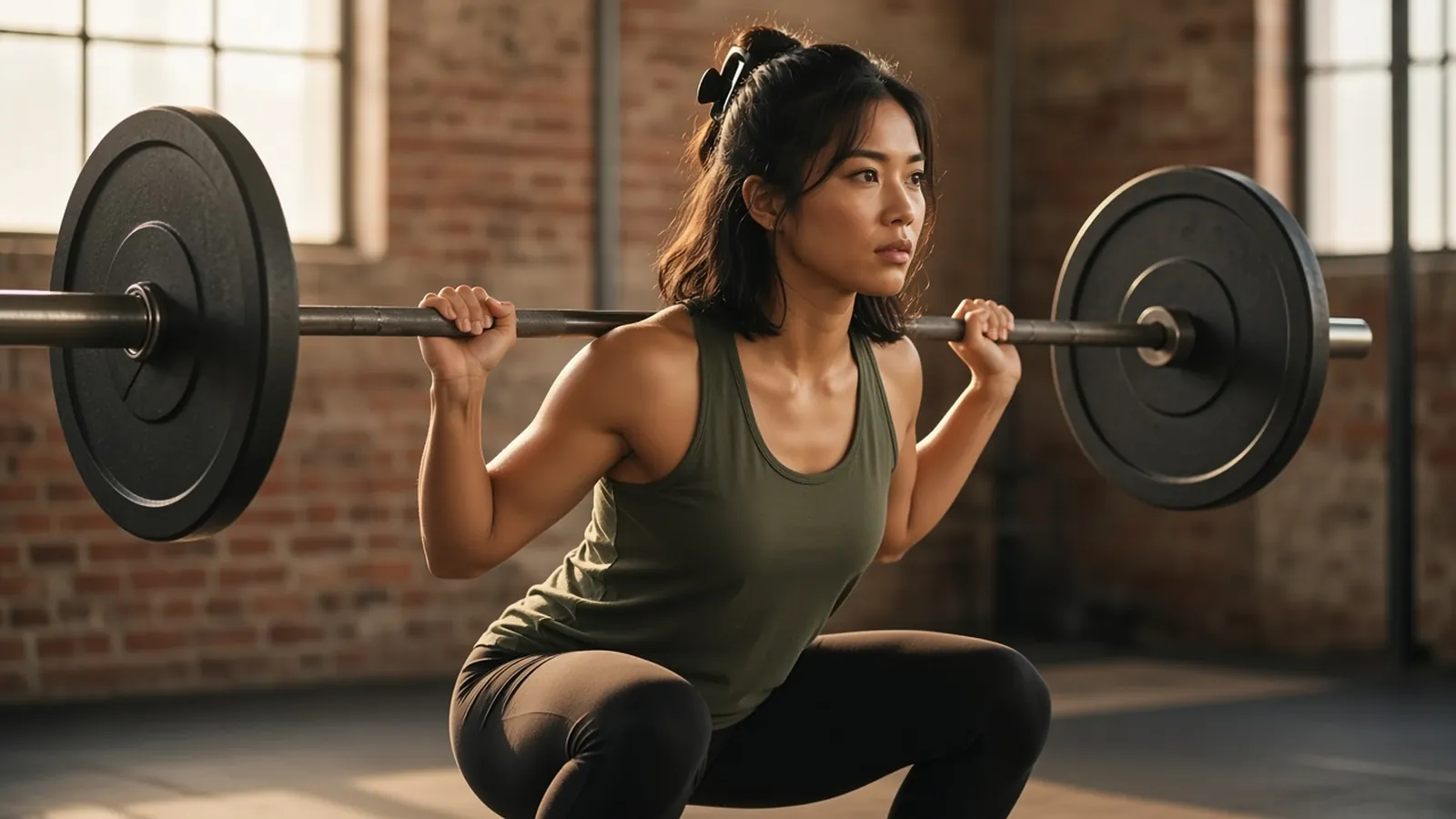
Cycle syncing has become one of the most talked-about ideas in women's training: heavy lifting in one phase, easy sessions in another, apps that tell you what to do each day. It sounds logical, since hormones do change across the cycle. But what happens when researchers actually measure strength and muscle?
This guide is for players and athletes in any sport (women's soccer, volleyball, field hockey, basketball, handball, track and field, rugby and more) and for the coaches and strength staff who work with them. It sums up what studies published in 2026 and earlier say about menstrual cycle training for strength, what changes and what doesn't, and how to use it in practice. It isn't medical advice: if you have severe pain, very heavy bleeding or changes in your period, see a healthcare professional.
The phases in two minutes
The cycle starts on the first day of your period. Roughly:
- Follicular phase. From your period to ovulation. Sex hormones start low, then estradiol rises.
- Ovulation. Around mid-cycle.
- Luteal phase. From ovulation to your next period. Progesterone rises.
Length varies from person to person and cycle to cycle. Not every athlete has regular cycles, and hormonal contraceptives, for example, change the pattern.
What the 2026 research says
A randomized trial: phase-based training gave no edge
In 2026, a McMaster University team in Canada published a randomized trial in Medicine & Science in Sports & Exercise with 24 healthy women with regular cycles (D'Souza et al., 2026). They trained legs over three consecutive cycles, about 12 weeks. Each leg was randomly assigned to one condition:
- no training (control),
- continuous training spread evenly across the cycle,
- high volume in the follicular phase and low in the luteal phase,
- or the reverse.
Every training condition improved muscle size and max strength compared with the untrained leg. Between the training conditions there were no differences. What tracked with the gains was training volume and load, not the phase. The authors conclude that phase-based adjustments can come down to personal preference but aren't needed to build strength and muscle.
A real-world training study: minimal effect of phase
Also in 2026, a study in Sports Medicine followed 28 strength-trained women through two supervised training blocks of about 8 weeks, using the bench press and trap bar deadlift (Munteanu et al., 2026). Phases were tracked with calendar counting, ovulation tests and blood hormone analysis, and bar speed was recorded on every rep.
Differences between phases were small, around 0.01 to 0.02 m/s versus what was expected. Motivation to train, on the other hand, predicted performance, and pain was linked to performance differently depending on the lift. The authors' takeaway: strength training can stay consistent through the whole cycle, though motivation and symptoms may play a role.
A third study, using isokinetic strength
Researchers from Brazilian universities published a 2026 study in the International Journal of Sports Medicine with 11 strength-trained women across six cycle phases, identified by calendar, ovulation tests and blood hormones (Velten et al., 2026). They found no differences in peak knee extension and flexion torque, fatigue over 60 reps or perceived exertion. It's a small sample, but it points the same way.
Before 2026
These findings didn't come out of nowhere:
- A 2020 meta-analysis of 78 studies found a trivial effect: performance might be slightly lower in the early follicular phase (the first days of the cycle), but with wide variation between studies and low-quality evidence. The authors recommended a personalized approach instead of general rules (McNulty et al., Sports Med, 2020).
- A 2023 umbrella review concluded it was premature to say cycle-related hormone swings meaningfully change strength or training adaptations, and flagged how poorly many studies identified phases (Colenso-Semple et al., 2023).
- On the other side, a 2022 review argued that follicular phase-based strength training might be superior (Kissow et al., Sports Med, 2022). The 2026 trial tested exactly that idea and found no advantage.
What really changes: symptoms, motivation and how you feel
If the phase itself matters so little, why do so many athletes feel worse on certain days? Because symptoms are real and they count. A 2026 narrative review suggests focusing on symptoms rather than phase: pain, fatigue, sleep problems, gut issues and fluid retention stand out as what most affects day-to-day training tolerance (Natalucci et al., Nutrients, 2026).
Heavy menstrual bleeding deserves attention too. In a 2016 survey, it was reported by 54% of online respondents, 36% of London Marathon runners and 37% of elite athletes, and only 22% had sought medical advice (Bruinvels et al., PLoS One, 2016). It's self-reported and from a specific population, but it shows how common it is and how often it goes unchecked.
What doesn't change: the basics
- Consistency. Regular strength training with progression is what tracked with gains in the 2026 trial.
- Well-planned volume and load. Still the main driver of adaptation.
- Technique. Bad technique doesn't get better in any phase.
- Recovery. Sleep is still part of training. See sleep for athletes.
Putting it into practice
- Track your cycle and how you feel. A simple note works: cycle day, energy, pain, sleep and drive to train on a 1-5 scale. After two or three months you'll start to see your own pattern.
- Adjust for symptoms, not the calendar. On a day with pain or low energy, you can cut volume, swap exercises or move the session. If you feel good, there's no reason to back off just because of the phase.
- Tell your strength coach. You don't need to share details. "I'm not at 100% today" is enough.
- Be skeptical of fixed rules. Apps promising the perfect workout for each phase go beyond what the research shows.
Sport-by-sport examples
- Women's soccer. In a game week, strength work usually sits away from match day. If a player shows up with symptoms, adjust the gym session without rewriting the whole week.
- Volleyball. Lots of jumping and shoulder load. On a painful day, serve technique or lighter upper-body work may fit better than intense plyometrics.
- Field hockey. Low positions and repeated accelerations. If the lower back or abdomen is bothering you, prioritize exercises you tolerate well that day.
- Basketball and handball. Contact, cuts and jumps. Lower-body and trunk strength can stay in place all cycle, adjusted to how the player feels.
- Track and field. In sprints and jumps, rep quality matters. Logging how you feel helps decide between a high-intensity day and a technique day.
- Rugby. Heavy contact and heavy strength blocks. Same rules: consistency, progression and adjusting for symptoms.
For coaches and staff
- Build trust. A player should be able to say "I'm in pain today" without embarrassment or consequences.
- The data is hers. Sharing cycle information is voluntary. If the team tracks it, do it with consent and restricted access.
- Don't program by phase for the whole roster. Every cycle is different and, according to the research, it isn't needed to build strength.
- Refer out. Strength coaches and athletic trainers don't diagnose. Recurring or worsening symptoms call for a doctor or gynecologist.
If you're a strength coach, athletic trainer or coach, you can show your background and experience with a staff profile.
When to see a professional
MedlinePlus, from the US National Library of Medicine, advises contacting a provider right away for fever with pelvic pain or sudden, severe pain, and also if treatment doesn't relieve the pain after three months, if you pass clots with the pain or if pain happens outside your period. The same source recommends seeing a provider if you've missed more than one period (absent menstrual periods). Decisions about hormonal contraceptives or any medication should always be made with your doctor.
Show your progress
Training consistently and tracking how you feel also leaves something visible: your progress. On ath.bio you can put your career history, sports data and best video in one link to send to clubs, coaches or colleges. The Free plan includes up to 3 career stages and one video. If you're looking for a chance to be seen, check out athletic scholarships in the USA or how to email college coaches.
FAQ
Can I lift during my period? Studies don't show that cycle phase meaningfully changes strength or adaptations. If you feel good, you can train. If you have pain or symptoms, adjust the session, and if it keeps happening, see a professional.
Should I plan my training by cycle phase? The 2026 trial found no advantage over training evenly across the cycle. You can do it if you prefer, but it isn't necessary to get stronger.
Are menstrual cycle training apps worth it? They can help you log your cycle and symptoms. Phase-specific training plans go beyond what the research shows.
What if I'm on hormonal birth control? A 2026 review found no consistent performance benefits from hormonal contraceptives. Any medication decision belongs with your doctor.
This article is for information only and doesn't replace advice from a doctor, gynecologist or sports medicine professional.