
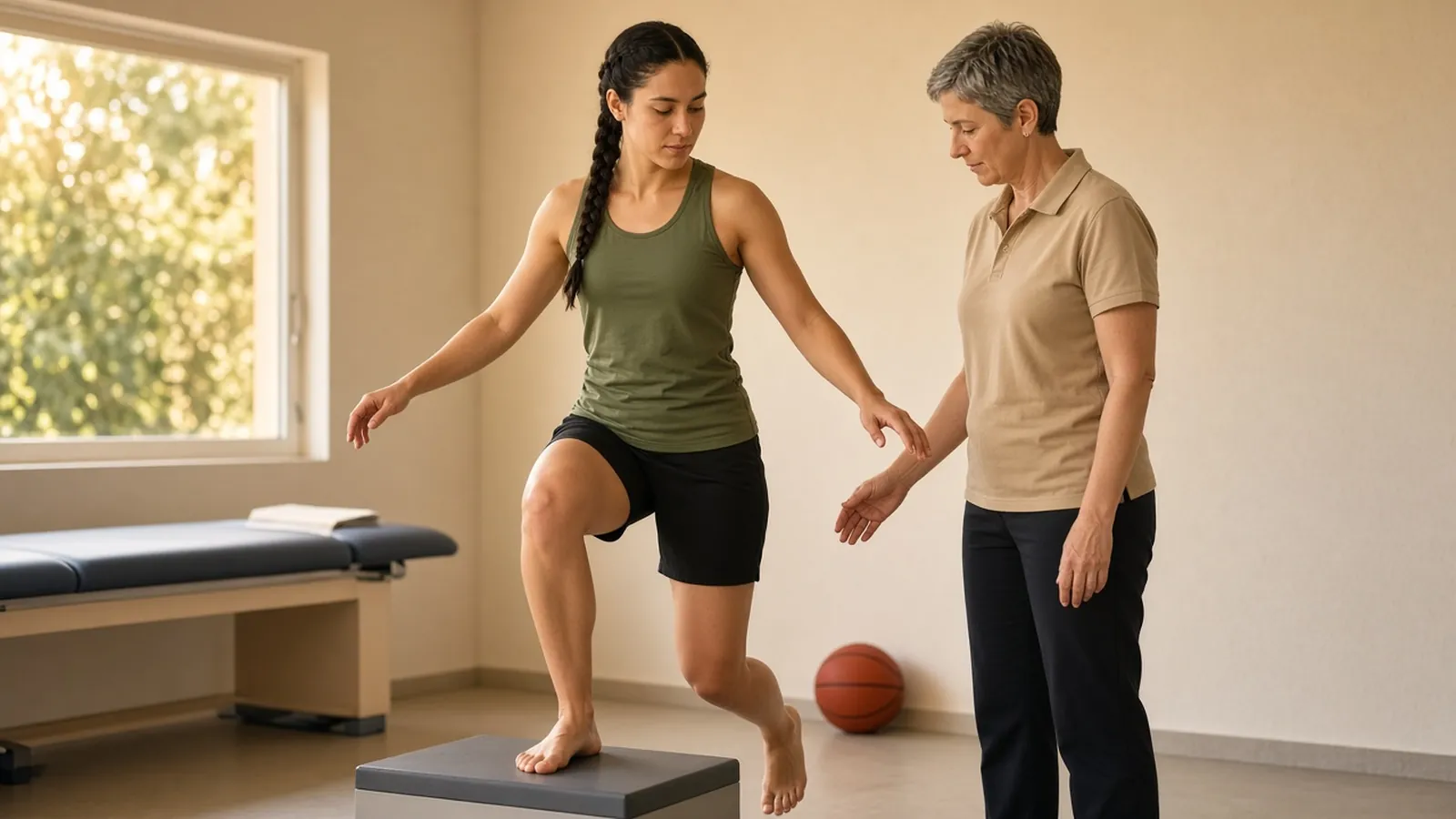
A landing after a rebound. A sharp cut to lose a defender. An awkward step coming down from a block. Many anterior cruciate ligament (ACL) tears happen without contact, in a fraction of a second, and can sideline a player for months. In women's handball, basketball, volleyball and soccer, it's one of the injuries players and coaches worry about most.
This guide is for female athletes and the staff around them: strength and conditioning coaches, athletic trainers, physical therapists and head coaches. It sums up what research says about why ACL injury in female athletes is more common, and what is known about preventing it with neuromuscular training programs. No program can guarantee you won't get hurt, and none of this replaces an assessment by a professional.
This article is for information only and is not medical advice. If you have knee pain, instability or an injury, see a sports medicine physician or orthopedic specialist and a physical therapist.
Why ACL injuries hit women's sport harder
A 2026 review in Clinics in Sports Medicine sets the baseline: female athletes have a significantly higher risk of ACL injury than male athletes, and the causes are multifactorial, with extrinsic, anatomical, genetic, hormonal and neuromuscular factors interacting (Manfre et al., 2026). The same review points to a second problem: women are significantly less likely than men to return to sport, often because of fear of re-injury or distrust of the knee.
A 2026 meta-analysis in the Journal of Athletic Training pooled 89 studies to compare ACL injury rates by sex, sport and level (Norman et al., 2026). The highest-risk groups were:
- women's semi-pro handball, 0.045 injuries per athlete per year,
- women's pro basketball, 0.027,
- women's pro alpine skiing, 0.025.
The authors stress that the data have large gaps and a lot of variability, and that it's still unknown whether the higher risk for women holds in every sport and level. They also note something uncomfortable: even though prevention programs work, ACL injury rates have stayed steady.
What 2026 research shows, sport by sport
Soccer: risk climbs with age and level
A study of every registered female soccer player aged 14 and up in the Málaga Football Federation (Spain) from 2020 to 2024 found 64 ACL injuries among 4,937 players (Gomez-Caceres et al., OJSM, 2026). Key numbers:
- 79.7% of injuries happened in matches,
- 82.8% were noncontact,
- professional players had the highest incidence, followed by players aged 16 to 18,
- compared with 14- and 15-year-olds, relative risk was about 5 times higher at 16 to 18 and about 15 times higher in professionals.
In practice: late adolescence and the jump to a higher level are exactly when prevention shouldn't slip.
Handball: alignment, anatomy and valgus collapse
A 2026 review on women's handball describes female players as more vulnerable than men to noncontact ACL injury. Knee alignment factors such as valgus (the knee caving inward) and hyperextension predispose players to the valgus-collapse mechanism seen in cutting and landing (Papadopoulou et al., Cureus, 2026). Bone shape and ligament characteristics play a part too. The takeaway: risk comes from several factors interacting, and understanding them helps target prevention and screening.
Many anatomical factors can't be changed. That's why day-to-day work focuses on what can be trained: how you land, how you decelerate and how you change direction.
Basketball: knee "wobbling" on landing
A 2026 pilot study followed 44 adolescent Japanese female basketball players for three years after filming them landing on one leg from a 30 cm (about 12 in) box (Aoki et al., Clin Biomech, 2026). Peak knee valgus angle didn't separate injured from uninjured players. What did show up was knee "wobbling," a repeated in-and-out movement of the knee during landing, seen in 5 of the 6 injured knees. It's a small study, but it suggests knee control on landing may be worth watching and training.
Volleyball
The sources we reviewed don't include volleyball-specific data. What does carry over is the principle they all share: landing and stabilization work, which is central in a sport built on constant jumping.
How the injury happens
An analysis of ten videos of noncontact ACL injuries in women's handball and basketball found strikingly similar patterns: immediate valgus within the first 40 milliseconds after foot contact, coupled with tibial rotation (Koga et al., AJSM, 2010). The authors concluded that prevention programs should focus on cutting and landing technique with a bent knee and without the knee caving in.
What works: neuromuscular training
Here's the good news. A meta-analysis of neuromuscular training programs to prevent ACL injuries in female athletes included 18 studies with 27,231 participants (Petushek et al., AJSM, 2019). The programs cut ACL injury risk from 1 in 54 to 1 in 111. Other useful findings:
- Start young. Programs for middle school and high school athletes reduced risk more than those for college or pro athletes, though both groups benefited.
- Typical dose. About 24 minutes per session, 2.5 times a week, across the season.
- What to include. More landing stabilization (jump or hop and hold) and lower-body strength work in each session improved the effect. The authors name Nordic hamstrings, lunges and calf raises.
- The coach matters. Every program included some form of training for the people delivering it.
For a deeper dive on one of those exercises, see our guide to the Nordic hamstring curl.
FIFA 11+: the most-studied example
FIFA 11+ is an injury prevention warm-up that replaces the usual one. In the original trial with 1,892 Norwegian female soccer players aged 13 to 17, the program had three parts: slow running with active stretching and controlled partner contact; six sets of strength, balance and jumping exercises, each with three difficulty levels; and faster running. Once players knew it, it took about 20 minutes (Soligard et al., BMJ, 2008). Before matches, only the running part was used.
That trial found fewer injuries overall, fewer severe injuries and fewer overuse injuries, though its primary outcome (lower-extremity injuries) didn't reach significance. A FIFA review notes injury reductions of up to 50% in female players aged 13 to 18 when the program was done at least twice a week, and that sticking to that frequency is key (Bizzini and Dvorak, BJSM, 2015). A 2017 meta-analysis estimated a 39% reduction in overall injuries with the 11+ in recreational and sub-elite soccer (Thorborg et al., BJSM, 2017).
A 2026 study in Japanese college players adds an important nuance. One season of 11+ made no difference in ACL injuries, but players who did it for three consecutive seasons had a significantly lower rate of noncontact ACL injury (Magoshi et al., JSMPF, 2026). It wasn't a randomized trial, but the message matches the rest of the evidence: prevention works when you keep doing it.
The 11+ was built for soccer. In handball, basketball or volleyball, the logic is the same: strength, balance, landing and cutting, adapted to the movements of each sport and led by someone trained to coach it.
For coaches and staff: fitting it into the warm-up
Most teams don't have spare minutes. The answer isn't adding a new block, it's upgrading the warm-up you already do.
- Replace, don't add. Use 15 to 25 minutes of your normal warm-up. Studies describe sessions of roughly 20 to 24 minutes.
- At least twice a week, all season. That frequency shows up again and again in the evidence. Plan for more than one season.
- Three blocks. Running and mobility; strength, balance and landing; then running with cuts. On game days, stick to the running and activation parts, as the 11+ does.
- Landing every session. Hop and hold on one leg, land with a bent knee, knee lined up over the foot. It was the component that added most in the meta-analysis.
- Lower-body strength. Nordics, lunges, calf raises, with progression. Coordinate with your strength coach so you don't double up on load.
- Watch how each athlete lands. A front-on phone video of a single-leg landing can show a knee caving in or wobbling. It's an observation, not a diagnosis.
- Train whoever delivers it. Every program in the meta-analysis trained its implementers. A badly done exercise prevents nothing.
- Make it part of the culture. When the head coach explains it and takes it seriously, the team sticks with it. When it's "the athletic trainer's thing," it fades in three weeks.
Sleep, load and the menstrual cycle
The Manfre review lists hormonal factors among many others. That doesn't mean skipping training in any phase of your cycle. If you want to know how the cycle and strength training interact, read our guide to menstrual cycle training. And since fatigue affects everything, it's worth revisiting sleep for athletes.
If you've already torn your ACL
Return to sport is a process with your physician, physical therapist and strength coach, not a fixed calendar. The 2026 review calls for a multidisciplinary approach and holistic support, including help with fear of re-injury. Asking for that help is part of rehab too.
Show your work, not just your highlights
For a player, availability is part of your value to a club or a college program. With ath.bio you put your career history, sports data and best video in one link. The Free plan includes up to 3 career stages and one video. If you're a strength coach, athletic trainer, physical therapist or coach, you can also create a professional profile. To get more from it, read how to improve your athlete profile.
FAQ
Why are female athletes more likely to tear their ACL? Research points to multiple interacting factors: extrinsic, anatomical, genetic, hormonal and neuromuscular. There's no single explanation.
Can ACL injuries be prevented? Risk can be reduced, not eliminated. In one meta-analysis, neuromuscular training cut risk from 1 in 54 to 1 in 111 female athletes.
How often should an ACL injury prevention program be done? FIFA 11+ evidence points to at least twice a week, and the neuromuscular training meta-analysis averaged 2.5 sessions a week of about 24 minutes, throughout the season.
Does FIFA 11+ work for basketball or handball? It was designed and studied in soccer. Its principles (strength, balance, landing, cutting) apply to other sports, but it's best adapted with a professional.
When should girls start ACL prevention training? The meta-analysis found larger effects in programs for middle and high school athletes, and the soccer study showed risk rising from age 16.
This article is for information only and doesn't replace advice from a sports medicine physician, orthopedic specialist or physical therapist. No program guarantees you won't get injured.