
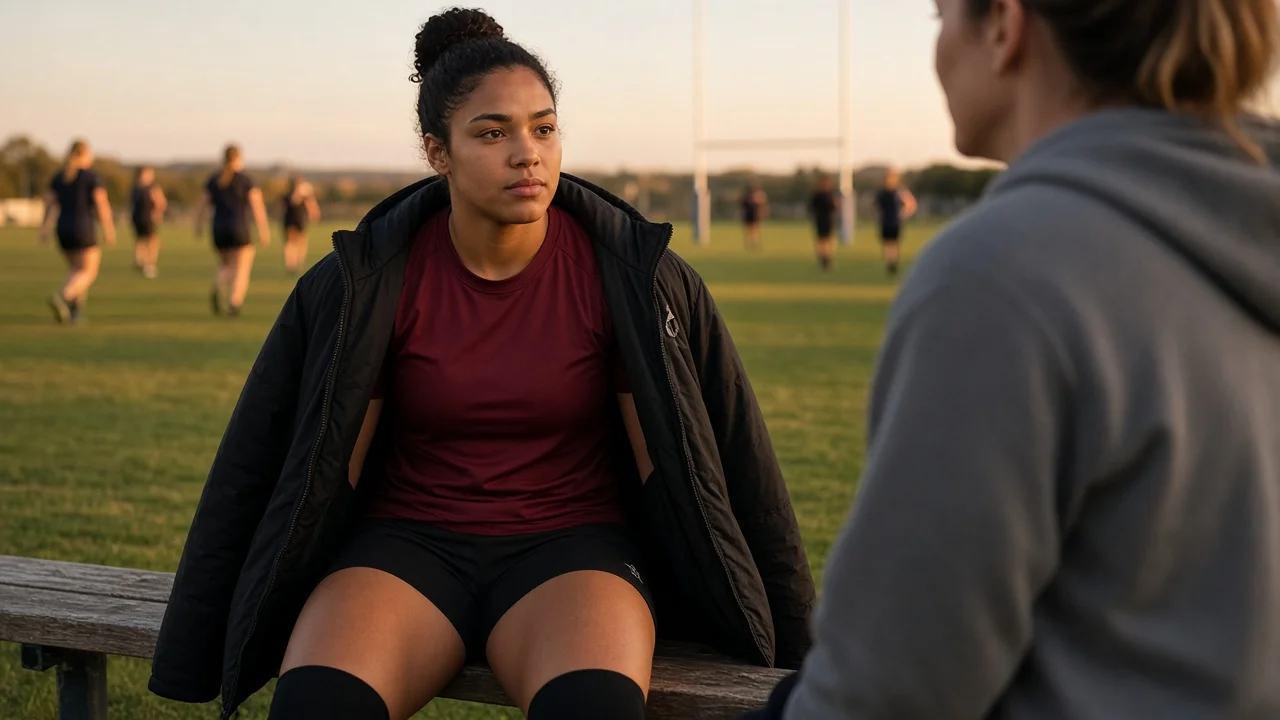
Two heads collide at a ruck. A stick catches a forward in the circle. An elbow lands under the rim. The player gets up, says they're fine and wants to keep going. A lot of how a concussion plays out is decided right there, in the next few minutes, and in what the staff does after that.
This guide is for rugby, hockey, soccer and basketball players, athletes in other contact sports, and the staff around them. It sums up the international Amsterdam consensus (2022) and studies published in 2026. It isn't a diagnosis or a treatment plan. If a concussion is suspected, a physician or a qualified healthcare professional makes the call.
What a concussion is
The Amsterdam consensus defines sport-related concussion as a traumatic brain injury caused by a direct blow to the head, neck or body that sends a sudden force to the brain (Patricios et al., BJSM, 2023). A few points worth knowing:
- It doesn't take a hit to the head. A hard hit to the body can cause one too.
- You don't have to black out. A concussion can happen with or without loss of consciousness.
- Symptoms can be delayed. They show up right away or develop over minutes or hours. They often clear within days, but sometimes last longer.
- A normal CT scan doesn't rule it out. Standard imaging doesn't show it.
Concussion symptoms
MedlinePlus, from the US National Library of Medicine, lists these symptoms of a mild traumatic brain injury or concussion (MedlinePlus):
- Headache.
- Confusion, trouble concentrating or not thinking clearly.
- Drowsiness or changes in sleep.
- Nausea or vomiting.
- Seeing flashing lights or sensitivity to light.
- Not remembering what happened right before or after the hit.
- Feeling like you've "lost time."
On the field, Amsterdam calls for immediate removal if any of these signs show up: loss of consciousness (or suspected loss), seizure, stiffening of the body after the impact, poor balance or coordination, confusion, behavior changes or memory loss.
When it's an emergency
Some signs point to something more serious and need medical care right away. MedlinePlus lists confusion that doesn't go away, seizures, weakness on one or both sides of the body, pupils of different sizes, unusual eye movements, repeated vomiting, trouble walking or with balance, and a longer loss of consciousness. A head injury can come with a neck injury, so don't move the player unless you know how.
"If in doubt, sit them out"
It's the simplest rule and the one that protects players the most. Amsterdam is clear: if a concussion is suspected, the player comes off. If they showed any of the signs above, they don't return that day, unless an experienced healthcare professional assesses them and concludes the sign wasn't caused by a concussion.
World Rugby breaks it into six steps (World Rugby, Recognise and Remove):
- Recognise the signs and symptoms.
- Remove the player right away, even if it's only a suspicion.
- Refer them to a healthcare professional trained in concussion.
- Rest before starting a graduated return.
- Recover fully, with no symptoms.
- Return only with written clearance from that professional, after completing the graduated return-to-play protocol.
World Rugby also recommends a more conservative return for children and adolescents.
Symptoms can change over the following hours and days. That's why the consensus asks for the player to be re-evaluated, even if they seem fine at the time.
The first days: relative rest, not lockdown
For years the advice was strict rest in a dark room until every symptom was gone. That has changed. A 2026 review in Clinics in Sports Medicine notes that current guidelines recommend getting back to daily activities, including walking, within 24 hours, guided by how symptoms respond (Diakogeorgiou and Dann, 2026).
What Amsterdam lays out for those first days:
- Relative rest for about the first two days: everyday activities and less screen time.
- Light activity, such as walking, as long as it doesn't make symptoms more than mildly worse.
- Stop if it gets worse. If symptoms go up by more than 2 points on a 0-10 scale, or last more than an hour, stop and try again the next day.
- No contact, collisions or fall risk until a healthcare professional says it's safe.
- Watch sleep. Poor sleep in the 10 days after a concussion was linked to a higher risk of lasting symptoms. If that's happening, bring it up with your doctor.
The return-to-play protocol, step by step
Amsterdam 2022 lays out a graduated return in six steps (Table 2 of the consensus). Each step usually takes at least 24 hours.
- Symptom-limited activity. Daily activities that don't make symptoms worse, such as walking.
- Aerobic exercise. Light first, then moderate: stationary bike or walking at a slow to medium pace.
- Individual sport-specific exercise. Running, change of direction or individual drills away from the team, with no risk of a head impact.
- Non-contact training drills. Harder drills with the group, such as passing or multiplayer work.
- Full contact practice. Normal training.
- Return to sport. Normal game play.
Three rules hold it together:
- Steps 4 to 6 only start once symptoms have cleared (including during and after exertion) and a healthcare professional has signed off.
- If symptoms come back during steps 4 to 6, the athlete goes back to step 3.
- Before unrestricted return, the healthcare professional puts in writing that the athlete is ready, in line with local laws or league rules.
How long are you out?
There's no fixed number. According to the consensus, the full protocol takes at least a week, and unrestricted return usually happens within a month. In the studies it reviewed, the average was about 20 days. If symptoms persist, get worse or aren't improving after 2 to 4 weeks, a more complete evaluation and a referral to rehab are recommended. With symptoms beyond 4 weeks, the consensus calls for a multidisciplinary assessment.
Leagues, governing bodies and schools may have their own rules, sometimes stricter, especially for youth players. If your competition has a protocol, follow it.
What 2026 research shows
- Rugby: better protocols, more cases found. A systematic review and meta-analysis in BJSM pooled 98 studies with 10,591 concussions (De Sousa-De Sousa et al., 2026). It found about 9.7 concussions per 1,000 player-hours in rugby union and 9.2 in rugby league. In rugby union, the match rate was almost 11 per 1,000 hours, compared with 0.34 in training. Studies that used the Head Injury Assessment (HIA) protocol reported nearly twice as many concussions, which the authors attribute to better detection. Female players under 18 had a higher rate than males of the same age.
- Youth ice hockey: medical clearance matters. In a study of players aged 11 to 17 who had two or more concussions, those who returned without medical clearance had four times the risk of a second concussion. Those who returned with clearance showed no added risk (Yusuf et al., J Sci Med Sport, 2026). Only 20 players were included, so there's a lot of uncertainty.
- After a concussion, other injuries. The Clinics in Sports Medicine review points out that the risk of musculoskeletal injury goes up after a concussion. It recommends adding motor control and cognitive skills work before a full return.
- Teenagers. A review in the Southern Medical Journal stresses that diagnosis is clinical. Tools like the SCAT6 help on the sideline, and the return to school and sport is matched to each athlete's symptoms. It also highlights sleep, hydration and nutrition (Casella and Hergenroeder, 2026).
Prevention: what has worked
Amsterdam brings together some concrete numbers:
- In youth ice hockey, banning body checking cut game concussions by 58%.
- In ice hockey, mouthguards were linked to a 28% lower concussion rate.
- In American football, limiting the number and intensity of contact practices led to a 64% drop in practice concussions.
- Neuromuscular warm-ups and good management of each concussion, to prevent repeat injuries, are also recommended.
For coaches and medical staff: protocol and records
- Have a written protocol before the season starts. Who decides on removal, who assesses, where the athlete is referred and who signs the clearance.
- The player and the head coach don't make the call. If in doubt, they sit out. The scoreboard has no say.
- Keep the tools at hand. The consensus released free tools: the CRT6, to recognize a possible concussion, and the SCAT6, used for assessment in the first 72 hours (up to a week).
- Log every episode. Date, how the impact happened, symptoms, who assessed, the date each step started and when written clearance was given. Without records there's no follow-up, and they also help flag players with a history of concussions.
- Think about school. Return to learn goes hand in hand with return to sport.
- Look after mental health too. The IOC consensus on mental health asks staff to watch for emotional symptoms after a concussion. We cover it in our guide to athlete mental health.
- Educate the squad. Everyone should know the signs, and speaking up shouldn't be seen as weakness.
Your career, in one place
A concussion can keep you out for a few weeks, but it doesn't erase what you've played. On ath.bio you build a profile with your history, your stats and your best video in one link, so a club, a college program or a coach can find you when they're looking for players. The Free plan includes up to 3 career stages and one video. To get the most out of it, read how to improve your athlete profile.
If you're a team physician, athletic trainer, physical therapist or strength coach, you can show your training and experience in a professional staff profile.
FAQ
What are the symptoms of a sports concussion? Headache, confusion, dizziness or poor balance, nausea, light sensitivity, drowsiness and memory problems, among others. They can show up right away or over the next few hours, and you don't have to lose consciousness.
Can you keep playing after a hit to the head? Not if a concussion is suspected. The player comes off and doesn't return that day, unless an experienced healthcare professional rules out a concussion.
What are the return-to-play steps after a concussion? Under the Amsterdam consensus: symptom-limited activity, aerobic exercise, individual sport-specific exercise, non-contact drills, full contact practice and return to sport. Each step usually takes at least 24 hours.
How long are you out of sports with a concussion? It depends on the case. With six steps of at least 24 hours each, the protocol takes at least a week. Unrestricted return usually happens within a month.
Do you need complete rest after a concussion? No. Current guidelines call for relative rest for a day or two, then light activity such as walking if it doesn't make symptoms worse.
This article is for information only and doesn't replace an assessment by a physician. If a head injury comes with warning signs, seek emergency care.