
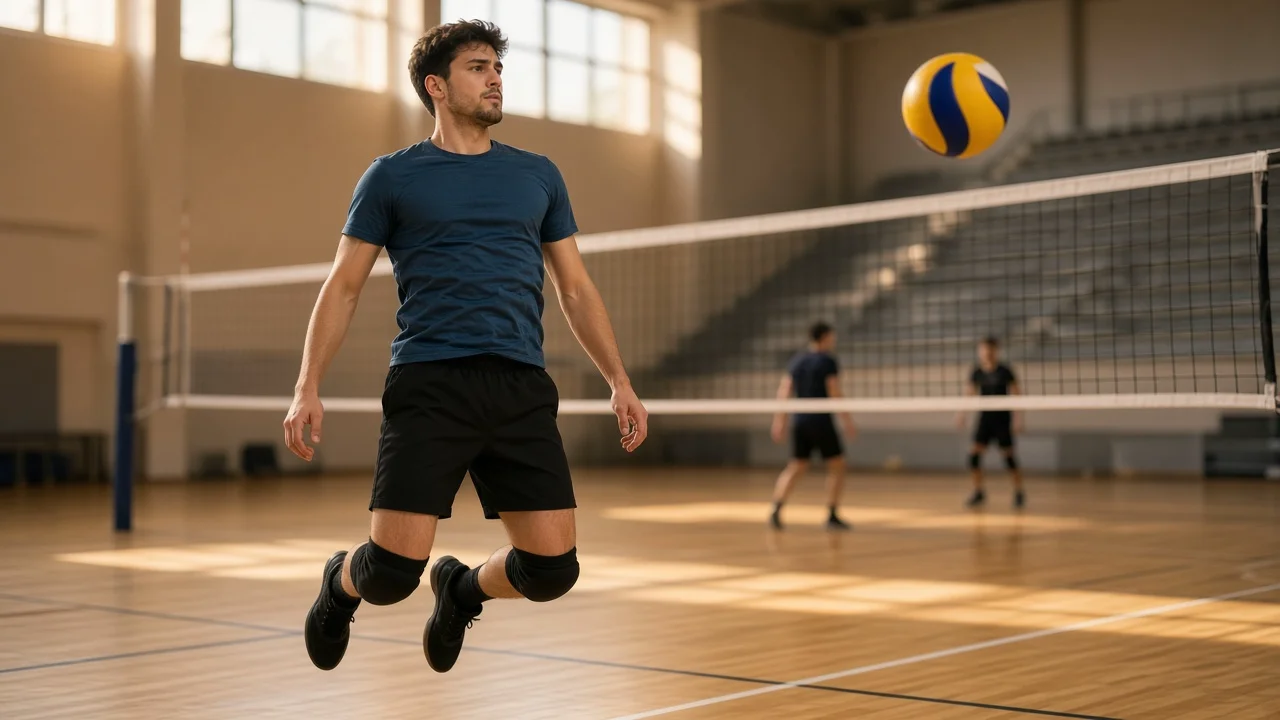
It hurts right below the kneecap. At first only during warm-up, then it fades. A few weeks later it shows up when you jump, land, take the stairs or stop hard. Volleyball and basketball players have a name for it: jumper's knee, or patellar tendinopathy.
This guide is for volleyball, basketball and handball players and for the coaches, athletic trainers and strength staff who plan their weeks. It covers what jumper's knee is, how common it is and what research published in 2026 shows. It is not a treatment plan. If your knee hurts, get it assessed by a physical therapist, athletic trainer or sports medicine physician.
What is jumper's knee?
It is persistent pain in the patellar tendon, the one that connects the kneecap to the shinbone. The pain shows up with load and comes with a loss of function. That is how a 2026 review on managing the condition in athletes defines it (Chen et al., Healthcare, 2026).
The typical signs, according to that review:
- Pain in one specific spot, at the bottom edge of the kneecap.
- Pain that rises with demand: jumping, landing, cutting, single-leg squats.
- Reduced performance: you jump less or protect the knee when you land.
- A long timeline: symptoms can last months or years.
Tendinitis or tendinopathy? Clinicians now prefer "tendinopathy" because classic inflammation isn't always present in the tissue. Plenty of people still search for "patellar tendonitis," but they're describing the same problem.
Why it's so common in volleyball and basketball
The patellar tendon works like a spring. It stores energy when you land and gives it back when you take off. Sports built on repeated jumps and landings load it over and over.
The Chen review pulls together the numbers:
- A meta-analysis of 28 studies with more than 28,000 participants found patellar tendinopathy in about 18% of athletes: 24.8% in volleyball, 20.8% in basketball and 6.1% in soccer.
- A Norwegian survey of elite athletes found it in 44.6% of volleyball players and 31.9% of basketball players.
- In a 15-year follow-up, more than half of athletes with a history of jumper's knee had retired from their sport because of knee problems.
That's not a minor ache. Don't wait until the pain takes you off the court to get it checked.
What a 2026 study in elite volleyball found
Researchers at the University of Porto assessed 78 first-division volleyball players in Portugal, all over 18, using a pain questionnaire and ultrasound of both knees (Reis et al., J Sports Med Phys Fitness, 2026). Their findings:
- More hours, more risk. Each extra hour of weekly training was linked to higher odds of jumper's knee (odds ratio 1.37).
- Men more than women. In this sample, male players were much more likely to have it than female players (odds ratio 4.41).
- Position: a trend, not a finding. Hitters and setters showed higher odds than liberos, but the difference wasn't statistically significant.
It's a small cross-sectional study, so it shows associations, not causes. Still, it lines up with what anyone working in volleyball sees: jump volume and training hours matter.
Teenagers: a critical window
A 2026 editorial in the British Journal of Sports Medicine argues for a different approach (Edwards et al., BJSM, 2026). Its main points:
- In adolescent athletes, patellar tendinopathy is the most common lower-limb tendinopathy.
- Most interventions have been studied in adults, not during the growth spurt, when the tendon is more susceptible to structural change.
- Imaging isn't needed to diagnose tendinopathy. But structural changes in athletes with no pain were linked to a ninefold higher risk of developing symptoms later.
The Chen review adds two points. In adolescents, the condition shows up more during the growth spurt. And over that same period, training can go from about 5 hours a week to more than 15. The authors note that this mismatch between load and tendon adaptation is a hypothesis that hasn't been proven directly.
A narrative review on youth volleyball points the same way. It argues for adjusting load to each player's maturity, not just age, and calls for volleyball-specific trials to confirm it (Chen, Liu and Hong, Front Sports Act Living, 2026).
What the research says about treatment
This is not medical advice. It's a summary of what has been studied, so you walk into your appointment knowing what to ask.
- Exercise is the most studied option. The 2026 review calls it a reasonable first-line approach. No single type of loading has proven clearly better than another, and the certainty of the evidence is low to very low.
- A 2026 trial of eccentric exercise. Forty volleyball, basketball and handball players with patellar tendinopathy were randomized into two groups (Fendri et al., J ISAKOS, 2026). One did 12 weeks of decline squats with progressive load. The other just kept playing. Thirty finished the study. The exercise group improved balance, quadriceps strength and pain; the control group didn't. It's a small trial, but a randomized one.
- Injections. Most data are short term and usually combine the injection with exercise, so it's unclear how much the injection adds on its own.
- Shockwave therapy. Current evidence doesn't support it as a first-line or stand-alone treatment.
- Straps and taping. They may ease symptoms in the short term, but they don't change the underlying problem.
- Imaging doesn't call the shots. Plenty of athletes without pain have changes on ultrasound, and what the scan shows often doesn't match the symptoms. That's why the review says load progression should follow how the athlete responds, not the images.
How many sets, how much load, when to jump again: that's for the clinician who follows you to decide, based on your pain and your sport.
Return to play
There are no validated criteria for clearing an athlete with jumper's knee. The 2026 review suggests looking at four things, always individually:
- How pain responds during and after loading.
- Function as reported by the athlete, for example with the VISA-P questionnaire.
- Strength and the ability to jump and land.
- Tolerance to jumping, landing and cutting again in sport-specific drills.
Psychological readiness also matters. It isn't a pass-fail test. It's a progression.
For coaches and staff: load and jump volume
- Track hours and jumps. The Porto study linked more weekly hours with higher risk. You can't adjust volume you don't measure.
- Watch the spikes. Preseason, tournaments with back-to-back games and the overlap of club and national team are heavy periods.
- With teenagers, look at maturity. Two 14-year-olds can be at very different points in their growth spurt. Recent literature asks staff to adapt load to that.
- Ask about knee pain. Pain below the kneecap when jumping deserves an early referral, not "play through it until the season ends."
- Don't rely on ultrasound alone. A tendon that looks abnormal on a scan but doesn't hurt is not the same as an injury.
- Refer. Diagnosis and the loading plan belong to the physical therapist, athletic trainer or physician.
There is early evidence in favor of prevention in teenagers. According to the 2026 review, a high-load exercise program in youth handball and an individualized program in elite youth volleyball and basketball showed favorable results. These are small studies with different populations and programs, so they aren't enough to recommend one protocol. If you work with female athletes in jumping sports, our guide on ACL injury prevention in female athletes is also worth a read.
Your career shows up in your profile
A knee injury can cut a season short, but it doesn't erase what you've played. On ath.bio you build a profile with your history, your stats and your best video in one link, so a club, a college program or a coach can find you when they're looking for players. The Free plan includes up to 3 career stages and one video. To get the most out of it, read how to improve your athlete profile.
If you're a physical therapist, athletic trainer, strength coach or sports physician, you can show your training and experience in a professional staff profile.
FAQ
What is jumper's knee? It's patellar tendinopathy: pain in the tendon below the kneecap that shows up with load (jumping, landing, cutting) and limits performance.
What are the symptoms of jumper's knee? Pain at the bottom edge of the kneecap that gets worse when you jump, land or do single-leg squats. It may start only during warm-up and become more persistent.
Does a knee strap or brace help jumper's knee? A 2026 review found that straps and taping may ease symptoms in the short term, but they don't change the underlying problem.
What is the treatment for jumper's knee? Progressive loading exercise is the most studied option and is considered a reasonable first line, though the evidence is low certainty. Your specific plan should come from a physical therapist or physician.
Why is jumper's knee so common in volleyball and basketball? Both sports involve a high number of jumps and landings that load the patellar tendon. Pooled data put prevalence at 24.8% in volleyball and 20.8% in basketball, compared with 6.1% in soccer.
This article is for information only and does not replace an assessment by a physician or physical therapist.