
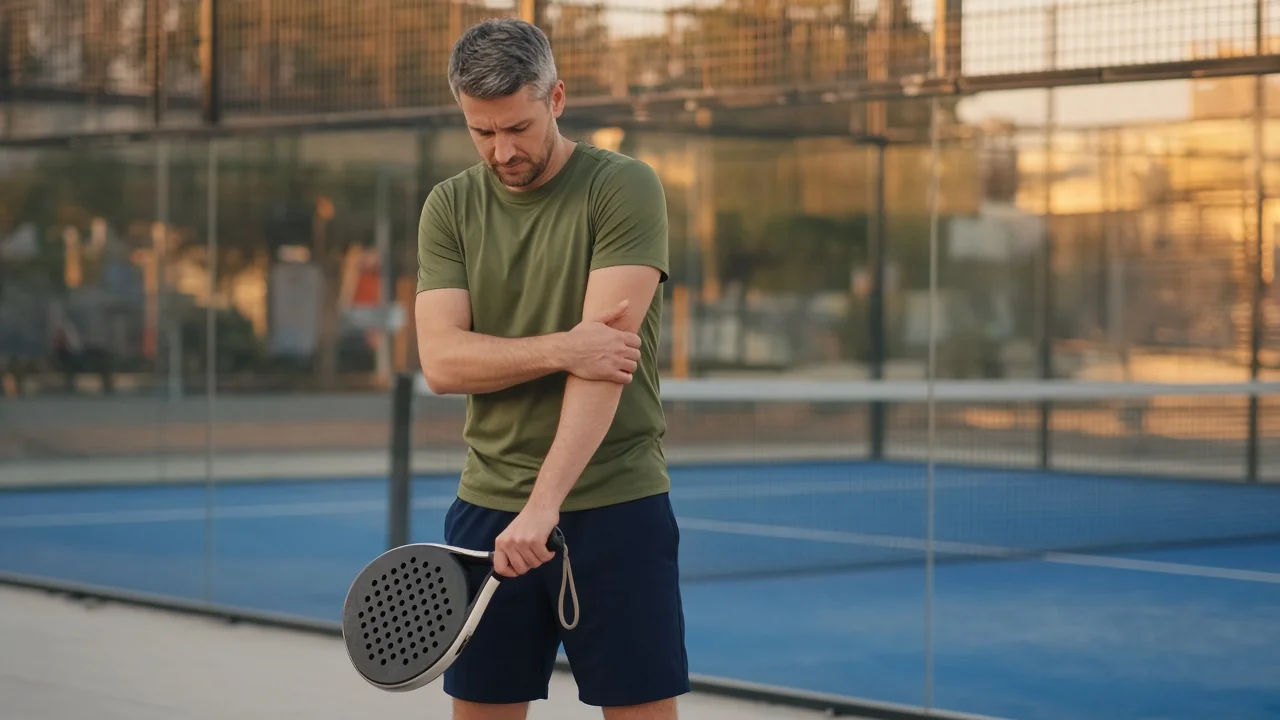
It starts as a dull ache on the outside of your elbow after a long match. Then it hurts to grip the racket, open a jar or shake hands. One day your backhand just isn't there. In padel and tennis it has a familiar name: tennis elbow, or lateral epicondylitis.
This guide is for padel and tennis players, recreational and pro, and for coaches and physical therapists. It covers what tennis elbow is, why it's so common in padel, what research says about rackets and what's known about treatment. It isn't a treatment plan. Your diagnosis and plan should come from a physical therapist or physician who examines you. If you play pickleball, much of this will sound familiar, but the studies below come from padel and tennis.
What tennis elbow is
It's a tendinopathy of the muscles that extend the wrist and fingers, where they attach to the outside of the elbow, the lateral epicondyle. The tendon most often involved is the extensor carpi radialis brevis. That's how a 2026 review in Life describes it (Biedroń et al., 2026).
A few points from that review:
- It's more degeneration than inflammation. That's why "lateral elbow tendinopathy" is now the preferred term, even if "epicondylitis" is still the most common one.
- It isn't just a tennis player's problem. Fewer than 10% of people with tennis elbow play tennis. It affects 1% to 3% of the general population and is most common between ages 35 and 54.
- Diagnosis is clinical. It's based on history and a physical exam. Ultrasound or MRI is used in cases that don't improve, to rule out other causes.
Symptoms: where it hurts
- Pain on the outside of the elbow, which can spread down the forearm toward the wrist.
- Pain when gripping: the racket, a mug, a bag held with the arm straight, a handshake.
- Pain when extending the wrist against resistance, as in a backhand.
- Tenderness when you press on the bony point on the outside of the elbow.
The UK's NHS adds that you may have trouble fully straightening your arm and that, in worse cases, the pain can disturb your sleep (NHS).
Why it's so common in padel
A systematic review of padel injuries pooled 8 studies with 2,022 participants (Dahmen et al., BMJ Open Sport Exerc Med, 2023). What it found:
- The elbow was the most injured area, ahead of the knee, shoulder and lower back.
- Tennis elbow was the most reported specific diagnosis.
- There were about 3 injuries per 1,000 hours of training and 8 per 1,000 matches, with the caveat that the research is limited.
The authors suggest a few possible reasons: the number of overhead shots, and the fact that two-handed backhands are rare in padel, unlike in tennis.
What about tennis?
That's where the name comes from. A 2020 clinical review estimates that up to half of tennis players develop symptoms at some point, and lists poor stroke technique and a heavy racket among the factors (Cutts et al., J Orthop, 2020).
Your racket: what studies say
"Did my racket cause this?" is one of the most searched questions. The short answer: the racket matters, but it isn't the whole story.
- Women's padel, 2026. A study surveyed 80 players from the professional top 100 and 147 amateurs (Escudero-Tena et al., J Sports Sci, 2026). Tendon injuries were the most common, mainly in the elbow and shoulder. Racket shape was the only factor that significantly predicted injury, and in an exploratory analysis players using round rackets were more likely to get hurt. Amateurs had more injuries per hour of play than pros (2.69 vs 0.67 per 1,000 hours). But the share of players injured over the year was higher among pros (61.1% vs 40.1%).
- Amateur padel, 2022. In 950 amateur players, men had more elbow tendon injuries. The authors conclude that racket features, weekly volume, experience and sex all need to be considered in injury prevention (Muñoz et al., 2022).
- Saudi Arabia, 2026. Among 600 surveyed players, half reported at least one injury, and upper-body injuries were the most common. Racket hardness was linked to where the injury happened. The authors note that follow-up studies are needed to know what actually causes it (Albesher et al., 2026).
These are survey studies. They show associations, not causes. There's no proven "tennis elbow friendly" racket. If your elbow hurts, check your racket with your coach, but also look at how much you play and how you hit.
The shoulder matters too
A 2026 pilot study compared padel players with pain on the outside of the elbow to players without pain (Morales-Rodríguez-Parets et al., Sports, 2026). Shoulder strength, muscle activation and grip strength were similar. But on the painful side, the shoulder had less internal rotation and the elbow tendon was thicker. The authors read this as a whole-arm, kinetic chain issue, not just an elbow problem. It's a pilot study, so it raises questions rather than answers them.
What research says about treatment
This isn't a recommendation. It's a summary of what's been studied, so you can walk into an appointment knowing what to ask.
- Physical therapy and load management come first. The 2026 review lists them as first-line care, including strengthening exercises for the forearm muscles.
- Steroid shots work fast, but the effect fades. In a trial with 198 people, the injection did better at 6 weeks, but many relapsed afterward: 47 of the 65 who had improved got worse again. Over the long term it did worse than physical therapy (Bisset et al., BMJ, 2006). In another trial with 165 people, at one year, those who got a steroid shot recovered less often (83% vs 96%) and relapsed more (54% vs 12%) than those who got a placebo shot (Coombes et al., JAMA, 2013).
- No treatment is much faster. A 2024 meta-analysis found no strong evidence that any option improves pain faster than placebo in the short and medium term. Physical therapy and exercise showed a benefit in the medium term (Lowdon et al., J Hand Surg Am, 2024).
- Several options, similar results. A 2026 trial with 98 patients compared laser, platelet-rich plasma, splinting, shockwave therapy and a steroid shot. All groups improved at 1 and 3 months, with no differences between them (Türköz et al., Ir J Med Sci, 2026).
- Braces and straps. According to the 2026 review, a counterforce brace can ease pain and improve grip in the short term. Over the long term, physical therapy did better.
- Time. In a good share of cases it settles on its own within one to two years. But the pain and loss of function make it worth treating. Only a minority, 4% to 11%, end up having surgery.
The NHS suggests seeing a doctor if the pain is still there after two weeks of rest and self-care. If you play often, don't wait until your elbow takes you off the court.
For coaches and physical therapists
- Watch for load spikes. More matches per week, weekend tournaments or coming back from a break and playing every day.
- Check the racket and grip with the player: shape, hardness, grip size. Without promising that a new racket will fix it.
- Work on technique, especially the backhand and overhead shots.
- Don't stop at the elbow. The 2026 evidence suggests looking at the shoulder too, though it's still preliminary.
- Track the pain. Which shot triggers it, after how many matches, how it feels the next morning.
- Refer. Diagnosis and the exercise plan are the job of a physical therapist or physician.
If you're interested in strength work for injury prevention, see our guide to the Nordic hamstring curl. And for tendinopathy in jumping sports, we have a guide on jumper's knee.
Your padel or tennis career, in one profile
Whether you play club tournaments, ranking events or are aiming for a college tennis program, your record is worth showing. On ath.bio you build a profile with your history, your results and your best video in one link, so a club, a college program or a coach can find you. The Free plan includes up to 3 career stages and one video. To get the most out of it, read how to improve your athlete profile.
If you're a physical therapist, strength coach or padel or tennis coach, you can show your training and experience in a professional staff profile.
FAQ
What is tennis elbow? It's a tendinopathy of the forearm extensor muscles where they attach to the outside of the elbow. It's also called lateral epicondylitis or lateral elbow tendinopathy.
Why do padel players get tennis elbow? A systematic review found the elbow is the most injured area in padel. The authors link it to the number of overhead shots and the fact that two-handed backhands are rare. Playing volume, technique and the racket also play a part.
Can a padel racket cause tennis elbow? It can play a role. A 2026 study in women's padel linked racket shape to more injuries, and other studies tie hardness and other racket features to injuries. These are associations, not proof of cause.
Can you play with tennis elbow? That depends on your pain and your sport, and it's a call to make with your physical therapist. Research supports adjusting load rather than ignoring the pain.
Does a tennis elbow brace or strap help? It may ease pain in the short term. Over the long term, physical therapy gave better results.
This article is for information only and does not replace an assessment by a physician or physical therapist.