
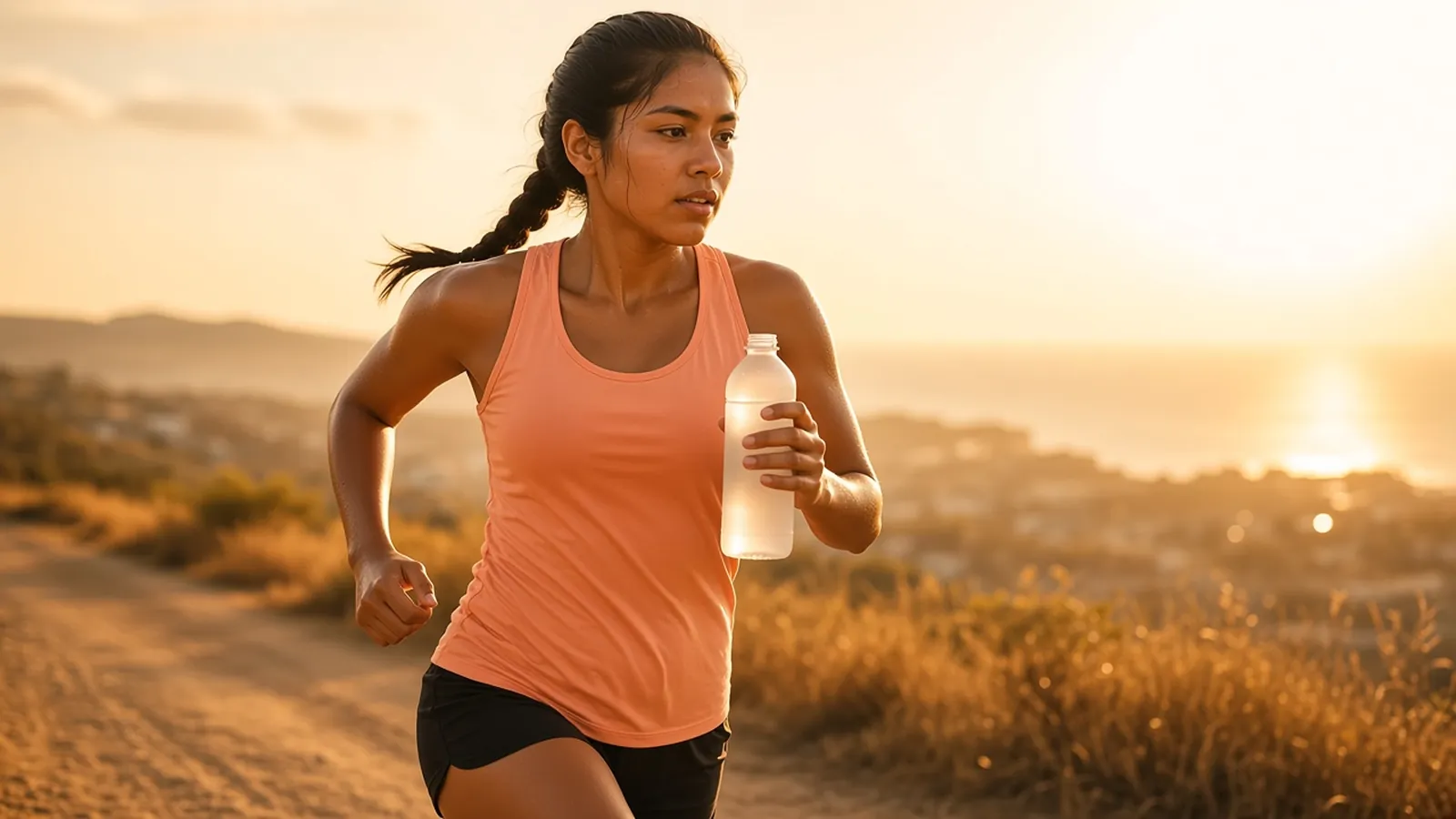
August two-a-days in Texas, a January tournament in Brazil, a summer half marathon that starts after sunrise: sooner or later most athletes have to train in the heat. Heat isn't just uncomfortable. It changes how your body responds, and if you ignore it, it can turn into an emergency.
This guide is for athletes and staff in any outdoor sport, including running, cycling, soccer, tennis, beach volleyball, rugby, football and field hockey. It covers how to approach training in the heat, what heat acclimatization is and how to do it, what consensus statements say about hydration, and which warning signs mean stop. It doesn't replace advice from a physician or athletic trainer. Heat stroke is a medical emergency. If you suspect it, call 911.
What heat does to your body
To get rid of heat, your body sends more blood to the skin and sweats more. That comes at a cost. The international consensus statement on training and competing in the heat, written by sports medicine specialists, physiologists and people working with sport federations, explains that heat raises cardiovascular and thermoregulatory strain, which is why endurance, racket and team-sport athletes perform at a lower intensity than in mild conditions. Add dehydration and the strain grows and performance drops further (Racinais et al., Br J Sports Med, 2015).
A 2026 practical guide for clinicians in the Revue Médicale Suisse puts it simply for athletes of every level: heat increases thermal, cardiovascular and perceived strain, can hurt performance and raises the risk of heat illness (Cattaneo et al., 2026).
Acclimatization is the main tool
Both papers agree on the key point. Heat acclimatization is the intervention that matters most. Hydration, nutrition and cooling help, but they don't replace it.
How long it takes
According to the 2015 consensus:
- Acclimatization comes from repeated exercise in the heat over one to two weeks.
- Most adaptations (lower heart rate, lower body temperature, more sweating) happen in the first week and keep developing more slowly after that.
- Trained athletes adapt faster than untrained people.
- A few days already help, but it can take 6 to 10 days for cardiovascular and sweating adaptations to be nearly complete.
- Most of the benefit holds for 2 to 4 weeks, and the body re-adapts faster the second time.
Training in mild weather gives you partial acclimatization, but it doesn't replace consecutive days of training in the heat. The consensus also notes that team-sport athletes acclimatized by training outdoors in the heat while keeping their regular schedule.
Dry heat or humid heat?
A 2026 study in the Journal of Physiology compared eight days of dry-heat and humid-heat acclimation in 22 trained male cyclists (10 dry, 12 humid). Adaptations were similar, and each group also improved in the other type of heat. In dry heat, the cyclists held higher power output at a similar effort (McDonald et al., J Physiol, 2026). It's a small group, all men and all cyclists, but it's good news if you live somewhere dry and compete somewhere humid, or the other way around.
Putting it into practice
- Go easier on the first hot days. Shorten sessions or lower the intensity, then build back up as your body adapts.
- Pick your time of day. Start in the cooler hours. If you'll compete in the afternoon, add some sessions at that time gradually.
- Go by heart rate or perceived effort, not your pace from a cool day. The same pace costs more in the heat.
- Set a goal and a stopping point. The 2026 guide says heat can be used as a training stimulus, but only with a clear objective and stopping criteria set in advance.
- Individualize it. Sport, schedule, personal tolerance and risk factors all change the plan.
Hydration without magic formulas
The 2015 consensus says to start training well hydrated and limit dehydration during exercise. It notes that many studies show aerobic performance in the heat drops once water losses go beyond roughly 2% of body mass. It also warns about the opposite problem: in long recreational events, people need to be careful not to overdrink, because overhydration is a risk too.
In cycling, the UCI nutrition consensus has a section on extreme environments. It covers managing fluids, carbohydrates and electrolytes, and how heat raises energy expenditure and carbohydrate use (Cheung et al., Int J Sport Nutr Exerc Metab, 2026).
In practice:
- Keep water available at all times and schedule breaks to drink.
- Show up hydrated instead of trying to catch up during the session.
- If you train for a long time and sweat a lot, electrolytes matter too. A sports dietitian can tell you how much and how.
- Skip alcohol before training in the heat.
Cooling before, during and after
The consensus describes several ways to lower skin and body temperature: ice packs, cold towels, cooling vests, cold-water immersion and ice-slurry drinks. Some work before a session, others during breaks. Test them in training, not on game day.
What it looks like in different sports
- Running and triathlon. Continuous effort, often in full sun. Run by feel and carry water or plan where you'll refill.
- Cycling. Moving air cools you and the heat feels milder on the bike, but rides are long. Plan fluids and carbs before you head out.
- Soccer, football, rugby and field hockey. Summer preseason, double sessions and lots of stop-and-go effort. Build in water breaks, use cooler hours and get shade on the sideline.
- Tennis. Matches have no set end time. Use changeovers to drink and cool down.
- Beach volleyball. Direct sun, hot sand and little shade. The consensus cites a survey of 48 beach volleyball matches over three years with only one heat-related medical forfeit, in an athlete coming off three days of gastroenteritis. Showing up sick changes everything.
Who's at higher risk
According to the 2015 consensus and MedlinePlus, risk goes up for people who:
- Aren't acclimatized, especially on the first hot days of the year or during heat waves.
- Are sick or recovering from an infection, diarrhea or a recent vaccination.
- Wear protective equipment or clothing that traps heat, like football pads.
- Drink alcohol or take certain medications.
- Are children.
One point from the consensus worth remembering: exertional heat stroke can also happen to someone who is acclimatized and has done the same activity many times before.
Warning signs
MedlinePlus, from the U.S. National Library of Medicine, describes a progression:
- Early signs. Muscle cramps, fatigue, thirst and very heavy sweating.
- Heat exhaustion. Cool, moist skin, severe thirst, dark urine, dizziness, headache, nausea or vomiting, weakness and a rapid, weak pulse.
- Heat stroke. Very high body temperature with neurological symptoms such as confusion, irrational behavior, seizures, slurred speech, extreme lethargy or loss of consciousness. Sweating may stop.
What to do if someone feels sick
- Stop the activity. No session or game is worth more.
- Move the person into shade or somewhere cool.
- Cool them down. Cool water on the skin, cold compresses on the neck, armpits and groin, and a fan if you have one.
- If they're alert and not vomiting, give them small sips to drink.
- Call 911 if there's confusion, a seizure, loss of consciousness, or if they don't get better.
MedlinePlus also lists what not to do: don't give fever medicine, don't give anything by mouth if the person is vomiting or unconscious, and don't use alcohol rubs.
For staff: a checklist before every summer session
- Check the forecast and the heat index for the session time.
- Plan water breaks and shade.
- Ask who's been sick or slept badly.
- Adjust the load for players who are just back or new to the group.
- Make sure everyone knows who calls for help and what to do if someone goes down.
Heat, sleep and tryouts
Hot nights can wreck sleep, and sleep is part of recovery. You'll find practical ideas in our guide to sleep for athletes.
If you have a tryout coming up in hot weather, acclimatizing is part of getting ready. See how to prepare for a soccer trial day and, if you're still looking for one, how to get a soccer trial.
Get your profile ready before the season
ath.bio puts your history, stats and best video in one link you can send to clubs, college coaches or agencies. The Free plan includes up to 3 career entries and one video. If you're a strength coach, athletic trainer or team physician, you can also build a staff profile.
FAQ
Is training in the heat good for you? The UCI consensus notes that heat training can have a transfer effect on performance, on top of preparing you to compete in hot conditions. The 2026 guide says heat can be used as a stimulus, but with a clear goal and stopping criteria. It's not something to experiment with on your own.
What about humidity? Humidity makes it harder for sweat to evaporate and cool you. In the 2026 study, dry and humid acclimation produced similar adaptations and cross-benefits.
How many days does it take to acclimate? The consensus says one to two weeks of repeated exposure. The first few days already help, and fuller adaptations can take 6 to 10 days.
Should I just drink when I'm thirsty? Researchers still debate it. The consensus says to start hydrated and avoid large fluid losses during exercise, without overdrinking in long events. If you're unsure, ask a sports dietitian.
This article is for information only and doesn't replace advice from a physician, athletic trainer or your coaching staff. Heat stroke is a medical emergency: if someone is confused, collapses or has a seizure, call 911.