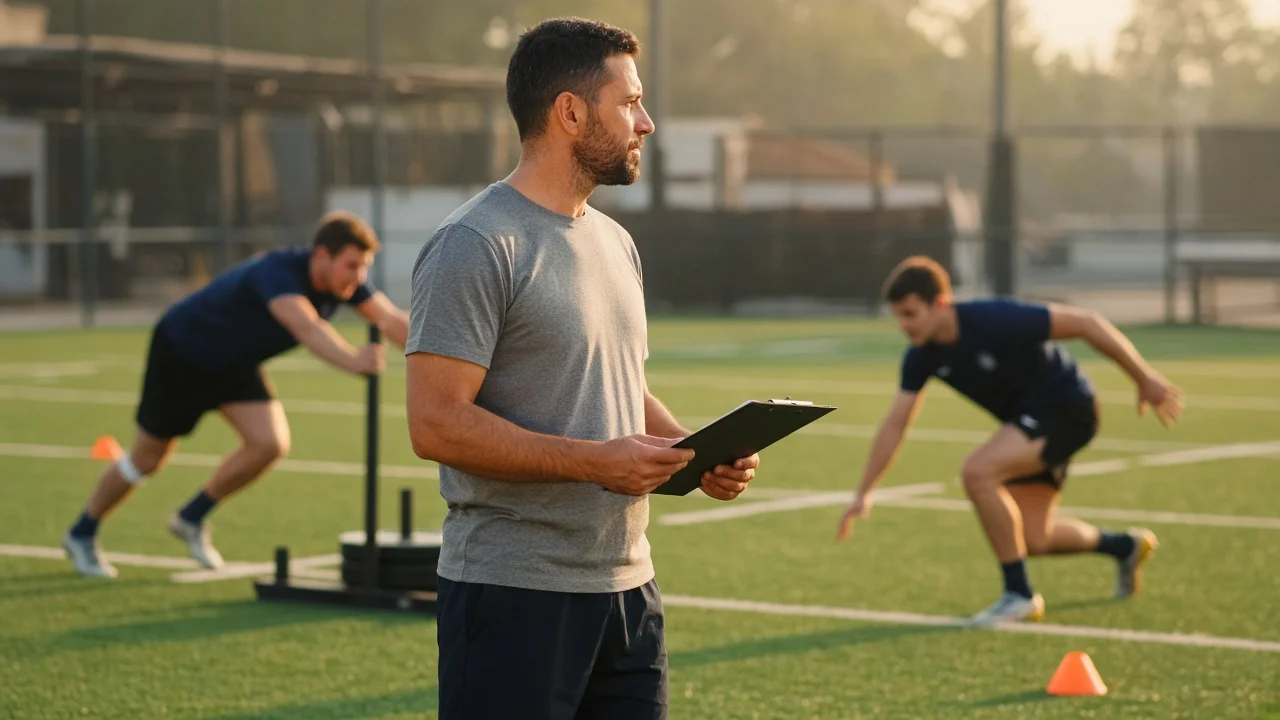
The off-season is when coaching staffs get rebuilt. If you're a kinesiology or exercise science student, a PE teacher or a coach trying to land your first team job in strength and conditioning, now is a good time to line up your education, certifications and resume.
This guide is for anyone who wants to work as a strength and conditioning coach in soccer, rugby, hockey, basketball or tennis. It covers what the job involves, what to study, which certifications matter and how to present your experience so a team takes you seriously. Requirements vary by country, league and sport, so check with your governing body or employer before you sign up for anything.
What a strength and conditioning coach does
South American soccer's licensing rules describe the role well: the person in charge of designing, implementing and supervising the team's physical conditioning plan, in coordination with the coaching staff (CONMEBOL Coaching License Convention 2026, in Spanish). That holds for any team sport. In individual sports like tennis, you build the plan with the player and their coach.
Day to day, that means planning the season, testing athletes, designing sessions, managing training load and working with the team physician, athletic trainers, physical therapists and dietitians. Two examples of what the job looks like in practice: building a preseason program and managing detraining in the off-season.
Step 1: get the degree
In the U.S., the main certification route starts with a college degree, often in exercise science or kinesiology. The NSCA's CSCS exam requires at least a bachelor's degree and a current CPR/AED certification. The NSCA has also announced that, from January 1, 2036, candidates will need a degree from a CASCE-accredited program (NSCA, CSCS certification). If you're choosing a program now, check whether it's accredited.
Outside the U.S., the base is usually a physical education or sport science degree. Some countries regulate the profession: in Brazil, for example, Law 9,696/1998 requires registration with a regional physical education council (CREF).
Step 2: get certified for your sport and market
CSCS (NSCA)
According to the NSCA, the Certified Strength and Conditioning Specialist (CSCS) is often preferred or required for roles such as assistant or head strength and conditioning coach and director of sports performance. The NSCA lists the knowledge areas it covers: exercise science, sport psychology, nutrition, exercise technique, program design, organization and administration, and testing and evaluation. According to the NSCA, many collective bargaining agreements in pro sports require the CSCS (NSCA).
Rugby
World Rugby runs a Conditioning for Rugby strand on its Passport platform: online introductions to conditioning for children, youth, adults and female players, plus an advanced level. Those modules are prerequisites for the face-to-face courses delivered with each union. Ask yours about dates.
Soccer in South America
If you're aiming at clubs in South America, CONMEBOL has three physical preparation licenses: B (youth up to U-15), A (U-16 to U-20 and third or fourth professional divisions) and PRO (first and second divisions). The B requires a PE teaching degree or equivalent; A and PRO require the previous license plus at least 80 hours of practice as a fitness coach in that category. Minimum course hours are 120, 120 and 180. Licenses are valid for three calendar years and are renewed with a refresher course of at least 20 hours (CONMEBOL Convention 2026).
Hockey, basketball and tennis
We didn't find a single, sport-specific S&C license for these sports like the one in South American soccer. In practice, coaches pair a degree with a general certification and sport-specific courses. Ask the league or club you're targeting what they require.
Step 3: log hours before your first job
Teams look for hands-on experience, and some licenses require documented hours. Ways to build it:
- intern or volunteer with a college, high school or club strength program;
- assist an experienced S&C coach with youth or amateur teams;
- work with individual athletes (tennis, track, golf);
- use the practicum built into your degree.
Keep records: hours, supervisors, teams, levels and seasons. You'll need them for certifications and for your resume.
Step 4: build a strength and conditioning coach resume
If you've read our guide to the soccer coach resume, the structure is the same, and it includes a section for fitness coaches. These are the parts that matter most for S&C:
- Education and certifications, with institution and year. If you're still studying, say "in progress."
- Experience by team, sport, level and season. If you've worked in rugby and hockey, make that obvious.
- How you coach. How you plan a season, which tests you use and how you monitor load. Two or three lines, no hype.
- Tools you use (load-monitoring software, testing equipment, spreadsheets).
- Who you've worked with. Head coaches, sports medicine, nutrition.
- References. A letter of recommendation from a coach or director carries real weight.
A useful way to think about your skills: in November 2026, researchers published a tool to evaluate S&C coaches, built with 213 elite coaches averaging 13.8 years of experience in leagues including MLB, MLS, the NBA, the NFL, the NHL and the Premier League, plus NCAA Division I (LaPlaca et al., J Strength Cond Res, 2026). It assesses skills, knowledge and experience. A reminder that a resume isn't just a list of certificates: how you coach and who you've worked with count too.
And if you train athletes who are looking for a team or a college roster spot, point them to our athletic resume template.
Step 5: land your first team
- Work your network. Professors, classmates and coaches you've assisted are usually the first door.
- Show your work. A sample training plan or testing report (without athletes' personal data) says more than a list of courses.
- Have one link to share. On ath.bio you can create a staff profile with your roles, education, specialties and the teams you've worked with. You can turn on contact requests and get them in Messages without a paid plan. It doesn't promise a job. It keeps your experience organized in one place that grows with you.
FAQ
What degree do you need to become a strength and conditioning coach? In the U.S., the CSCS exam requires at least a bachelor's degree, and many coaches study exercise science or kinesiology.
Can you become a strength and conditioning coach without a degree? Not through the CSCS route, which requires a bachelor's degree. Other roles and countries have different rules, so check what your target employer asks for.
Is the CSCS required to work in college or pro sports? According to the NSCA, it's often preferred or required, and many collective bargaining agreements in pro sports require it.
Does the same path work for rugby, hockey or basketball? The foundation does. What changes is the sport-specific coursework and what each governing body or employer expects.
What do I put on my resume if I haven't worked for a team yet? Internships, volunteer work, assistant roles, individual athletes you've trained and courses in progress, with dates, hours and supervisors.