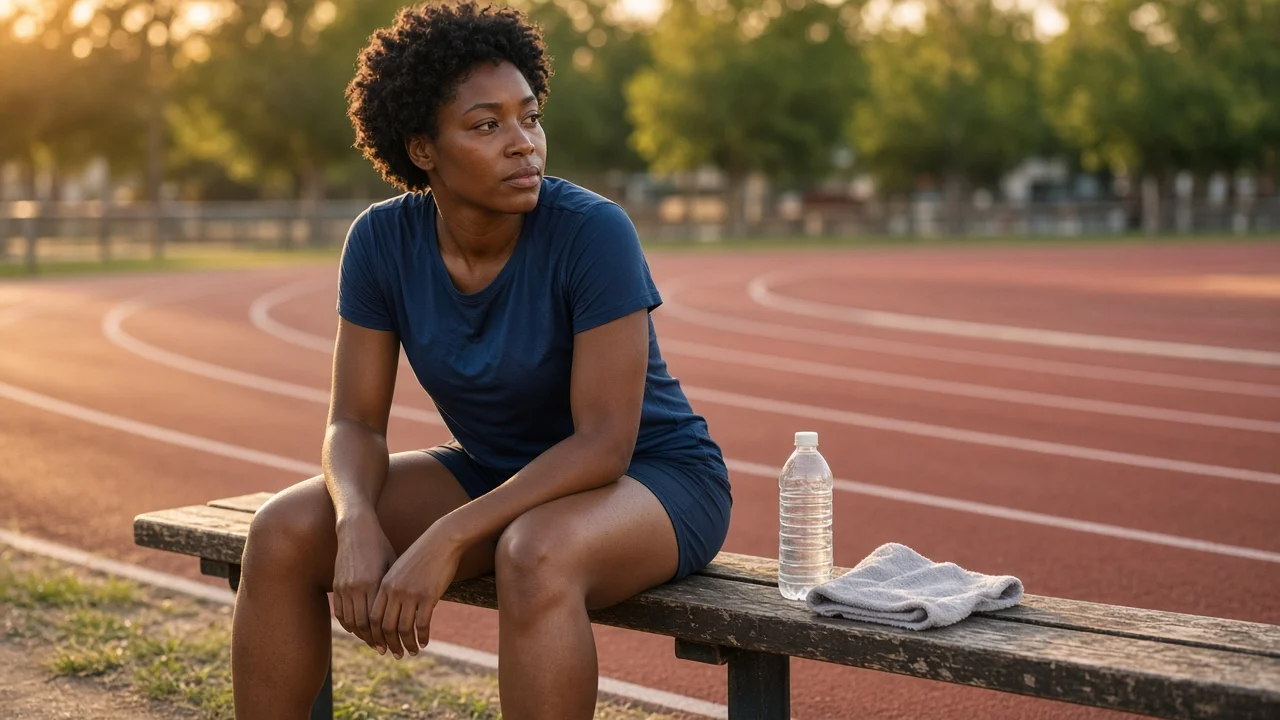
You're training harder than ever, yet you're getting slower, recovery drags and small aches never quite clear up. Sometimes the problem isn't the training plan. It's fuel: your body isn't getting enough energy to cover training and everything else it has to do. That has a name: Relative Energy Deficiency in Sport, or RED-S.
This guide is for female and male athletes in endurance sports, gymnastics, dance and team sports, and for the staff around them: team physicians, sports dietitians, strength coaches and coaches. It covers what RED-S is, why it happens, which signs to watch and what the latest research says. It isn't a diagnosis. If this sounds like you, talk to a doctor and a sports dietitian.
What RED-S is
The International Olympic Committee (IOC) introduced the term in 2014 to describe a syndrome of harmful health and performance effects in female and male athletes exposed to low energy availability: not eating enough relative to the energy spent in training (2023 IOC consensus statement, Br J Sports Med). It used to be known mainly as the Female Athlete Triad (Caldwell et al., Clin Sports Med, 2026).
The 2023 update drew on more than 170 new studies published since 2018. Three topics stood out: the role of low carbohydrate availability, the link with mental health and new data in men. Papers often write it as REDs. Same thing.
The key word is relative. It's not about eating "too little" in general. It's about eating too little for the load you carry.
Where it starts: low energy availability
Energy availability is, simply put, the energy left for your body to run on after paying for training. When too little is left for too long, the body starts cutting back on other systems.
Two nuances matter:
- Not every deficit is the same. The IOC's physiological model separates problematic from adaptable low energy availability and adds individual factors that change how each person responds (IOC consensus, 2023).
- There's no magic number. The 2025 update to the Female Athlete Triad consensus moves away from a fixed energy availability threshold to define the problem (Williams et al., Sports Med, 2026).
And it's often unintentional. In a study of 115 women college athletes across several sports, 64% were at risk of low energy availability, but only 8% were at risk of an eating disorder. The authors read this as undereating that often happens without anyone meaning to (Fields et al., J Strength Cond Res, 2026). Think of a season where training ramps up and meals don't keep pace.
Not just women, not just runners
- Men. The Male Athlete Triad consensus statements came out in 2021, applying what was known in women to male athletes (Kussman et al., Curr Rev Musculoskelet Med, 2026). In a study of 30 male boxers, judokas and weightlifters, 40% screened positive on a risk questionnaire. The authors note that signs in men are subtle and often blamed on training fatigue (Sundresh et al., Cureus, 2026).
- Team sports. A systematic review pooled 14 studies with 265 elite athletes from 12 team ball sports. Depending on the method, prevalence ranged from 0% to 80%. Bottom line: RED-S shows up everywhere, but the research is thin and needs a common way to measure it (Billingham et al., J Sci Med Sport, 2026).
- Dance. Among 232 college dancers, 50.4% reported some form of menstrual dysfunction. Those who did reported more injuries, and more severe ones (Seifert Gonzales and Galdamez, J Dance Med Sci, 2026).
- Endurance and aesthetic sports. That's where it's most expected, but it can happen in any sport (Sundresh et al., 2026).
Signs to watch
No single sign means RED-S. Several together are a reason to get checked. According to Cleveland Clinic, the more visible ones include:
- fatigue that your training load doesn't explain;
- a drop in performance and stamina;
- slower recovery between sessions;
- trouble sleeping;
- digestive issues (bloating, constipation, diarrhea);
- dizziness;
- hair loss;
- irregular or missing periods;
- more anxiety or low mood;
- stress fractures that keep coming back.
Others are harder to notice: a slower heart rate, bone density loss, more injuries, slow healing and getting sick more often. In men, the most consistent signal in the Sundresh study was lower sex drive.
A 2026 review describes RED-S as a syndrome that affects metabolic, reproductive, bone, cardiovascular and psychological health (Hulsey et al., JAAPA, 2026).
Bones, iron and immunity
Bone takes an early hit. Low energy availability is linked to more bone breakdown and less bone formation, which raises the risk of bone stress injuries. Low carbohydrate availability, even without an overall energy deficit, can also affect bone, iron metabolism and immune function (Catalan and Wiener, Curr Opin Pediatr, 2026). For the iron side, read our guide to iron deficiency in athletes.
The Triad update also adds bone stress injuries to the bone health spectrum (Williams et al., 2026).
Losing your period isn't a normal side effect of training
A missing or irregular period is one of the clearest signs, and it's worth getting checked. To understand how the cycle and training interact, see our piece on menstrual cycle training.
According to the Triad update, menstrual disturbances caused by energy deficiency can be reversed with a moderate increase in food intake. But a returning period doesn't mean you're fully recovered: ovulation and hormone levels take several consecutive normal cycles to come back (Williams et al., 2026).
How it's diagnosed
There's no single test. Your doctor will ask about training, eating and symptoms, examine you and may order blood work, X-rays or a bone density scan (Cleveland Clinic).
To grade risk, clinicians use the IOC's clinical assessment tool (REDs CAT2), which also guides training and competition decisions (IOC consensus, 2023). Questionnaires such as the LEAF-Q (women) and LEAM-Q (men) flag risk. They don't diagnose.
Treatment: it's about energy
The core of treatment is restoring adequate energy availability by improving macro- and micronutrient intake, while dealing with any consequences that have already shown up (Kussman et al., 2026). Depending on the case, training load is adjusted and psychological support is added (Hulsey et al., 2026). Sometimes a break is needed.
The ideal setup is a team: physician, dietitian and mental health provider, plus athletic trainers, physical therapists, coaches and family when it makes sense. There's no one-size-fits-all plan. What and how much to eat is something a sports dietitian works out with you. For one piece of the puzzle, see how much protein athletes need.
The mental side matters too. The IOC highlights the link between RED-S and mental health. If eating, training or thinking about food is stressing you out, tell someone you trust and see a professional. Our guide to athlete mental health is a good place to start.
For staff: prevention is also about how you talk
One 2026 review says RED-S is under-recognized by coaches, physicians and medical teams (Caldwell et al., 2026). Another puts prevention on education and healthy environments, especially in conversations about the body and performance (Kussman et al., 2026).
In practice:
- don't comment on athletes' bodies;
- watch for falling performance alongside fatigue, bone injuries or menstrual changes;
- refer to a physician and dietitian instead of handing out food advice;
- check the logistics of two-a-days and travel days, when eating gets harder.
If you're a dietitian, team physician or strength coach, you can build a staff profile on ath.bio with your specialty, education and the teams you've worked with.
FAQ
Is RED-S the same as the Female Athlete Triad? They're related. Both start from low energy availability. The Triad focuses on energy, menstrual function and bone. RED-S covers more body systems and athletes of any sex.
Can men get RED-S? Yes. There have been male-specific consensus statements since 2021 and new studies in men. Signs tend to be subtler, like lower sex drive or fatigue that gets blamed on training.
Do you need an eating disorder to have RED-S? No. It can happen by accident, when food intake doesn't keep up with training. If there is an eating disorder, care should include a mental health professional.
How do I know if I'm eating enough? There's no single number that works for everyone. If you have several of the signs above, see a doctor and a sports dietitian.
Can you recover from RED-S? Many effects improve once energy is restored, but it takes time. With the menstrual cycle, for example, hormones need several consecutive normal cycles to recover.
This article is for information only and doesn't replace advice from a doctor, dietitian or mental health professional.